 by
by Most websites do not suffer from a lack of content.
They have disconnected content.
A blog posts 30, 50 or even 100 articles and organic traffic barely grows. The common approach is to produce more content, target more keywords, or purchase SEO tools. But often the real problem is much simpler: the pages aren’t working together.
Google doesn’t rank pages in isolation. It measures relationships between pages, topics and user journeys. That’s where a solid internal linking strategy becomes one of the most underrated SEO benefits available today.
A strong internal linking structure helps search engines find content faster, understand topical relevance, distribute authority throughout the site, and lead visitors to the information they actually need. A weak structure means valuable pages are buried and unconnected.
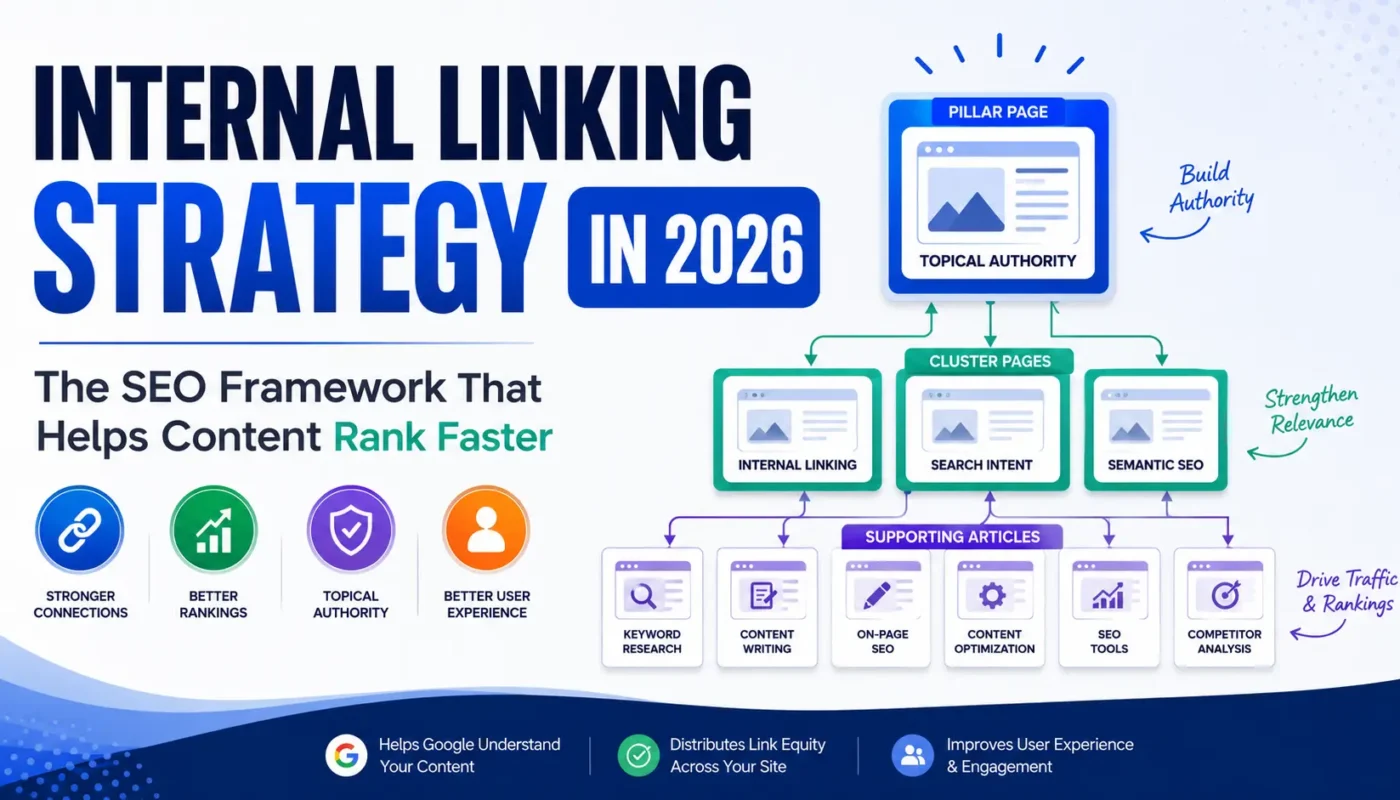
In this guide, you’ll learn how internal linking works in modern SEO, how it helps to build topical authority and the exact framework you can use to build a smarter website architecture in 2026.
What Is an Internal Linking Strategy?
Content Points
- Define internal links.
- Difference between internal links and backlinks.
- Why internal links are fully under your control.
- Explain how internal linking creates topic relationships.
- Introduce the concept of content pathways.
Key Insight
Most people think internal links exist primarily for navigation.
Search engines use them for understanding context.
A link is not merely a pathway.
It’s a signal.
Every internal link tells Google:
“These two topics are related.”
Why Internal Linking Matters More Than Ever in 2026
Content Points
- AI-generated content is everywhere.
- Search engines need stronger contextual signals.
- Internal linking helps establish expertise.
- Supports topical authority.
- Improves crawl efficiency.
- Helps distribute page authority.
Example Scenario
Compare:
Website A:
50 articles with random linking.
Website B:
50 articles connected through strategic topic clusters.
Both have similar content quality.
Website B often wins because its structure is easier for Google to understand.
The Three Jobs Every Internal Link Should Perform
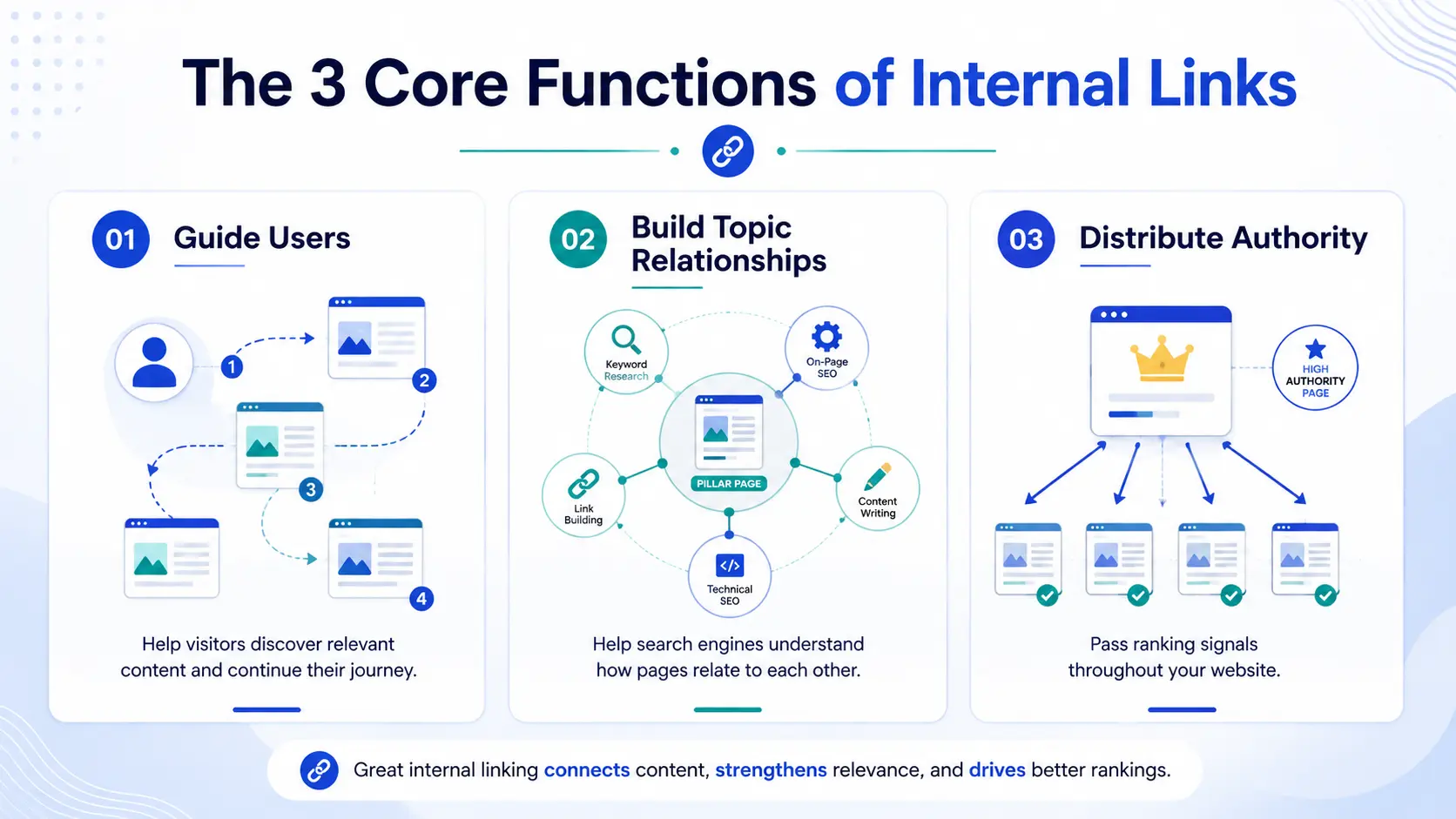
Job #1: Help Users Discover Relevant Content
Explain:
- Reduced bounce rate
- Increased engagement
- Better content consumption
Example:
A reader learning keyword research may naturally need information about content writing, topical clusters, and on-page SEO.
Job #2: Help Search Engines Understand Relationships
Explain:
Google builds topic maps.
Internal links provide context.
Example:
A page about topical authority linking to topic clusters creates semantic relevance.
How to Build Topical Authority for a Website
Job #3: Distribute Authority Across Your Website
Explain:
- Link equity
- Authority flow
- Strategic importance of linking from strong pages
Discuss why older pages often become authority sources.
The Biggest Internal Linking Mistake Most Websites Make
Content Points
Many site owners link randomly.
They add links simply because a keyword appears.
This creates:
- weak context
- poor relevance
- diluted structure
Practical Example
Bad:
Keyword Research → Local SEO Tools
Good:
Keyword Research → Search Intent → Content Brief → Content Creation → Topical Authority
One creates a logical journey.
The other creates confusion.
The Internal Linking Framework I Recommend
Section Intro
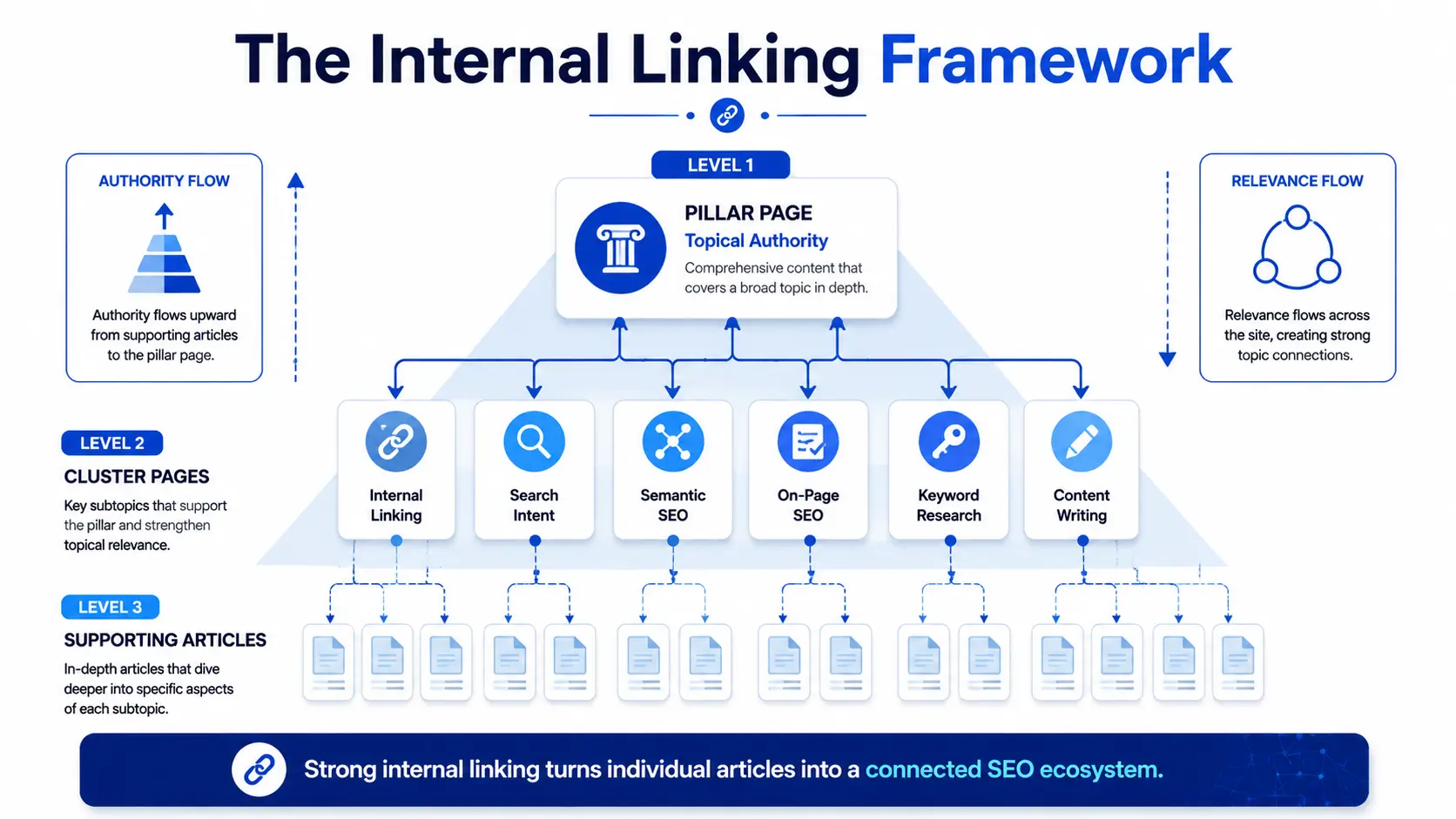
Rather than thinking about links individually, think about layers.
Layer 1: Pillar Pages
Explain:
Pillar pages target broad topics.
Examples:
- Topical Authority
- SEO Strategy
- Keyword Research
Characteristics:
- Comprehensive
- High-value
- Frequently linked to
Layer 2: Cluster Pages
Explain:
Cluster pages support the pillar.
Example:
Pillar:
Topical Authority
Cluster Pages:
- Internal Linking
- Content Silos
- Semantic SEO
- Search Intent
Discuss how clusters strengthen authority.
Layer 3: Supporting Articles
Examples:
- SEO Checklist
- Low Competition Keywords
- On-Page SEO
- Content Framework
Explain how supporting content feeds authority upward.
Internal Linking vs Backlinks: Which Matters More?
Comparison Table
Factor | Internal Links | Backlinks |
Control | High | Low |
Cost | Free | Often expensive |
Scalability | High | Limited |
SEO Impact | Strong | Strong |
Speed of Implementation | Immediate | Slow |
Key Takeaway
Backlinks remain valuable.
But most websites underutilize internal links they already control.
How Many Internal Links Should You Add Per Page?
Content Points
Avoid exact numbers.
Explain:
Depends on:
- page length
- topic complexity
- content depth
General guidance:
1000 words → 3–5 relevant links
2000+ words → 5–10 relevant links
Important Observation
The quality of the connection matters more than the quantity.
One highly relevant internal link can outperform ten weak ones.
Internal Linking and Topical Authority: The Missing Connection
Content Points
Many blogs discuss topical authority without discussing internal links.
That is a mistake.
Topical authority is not created only through content.
It is reinforced through relationships between content.
Internal Link Opportunity
Link naturally to:
- How to Build Topical Authority for a Website
- How to Build Topical Clusters That Rank
Explain
Topic clusters become visible to Google through internal linking.
Without links, clusters remain isolated articles.
Anchor Text Best Practices
Discuss
Good Anchor Text:
- SEO content writing framework
- topical authority strategy
- low competition keywords
Poor Anchor Text:
- click here
- read more
- this article
Nuance
Avoid over-optimizing exact-match anchors repeatedly.
Use natural language variations.
Common Internal Linking Mistakes That Quietly Hurt Rankings
Mistake 1: Linking Only From New Content
Explain why older content often carries more authority.
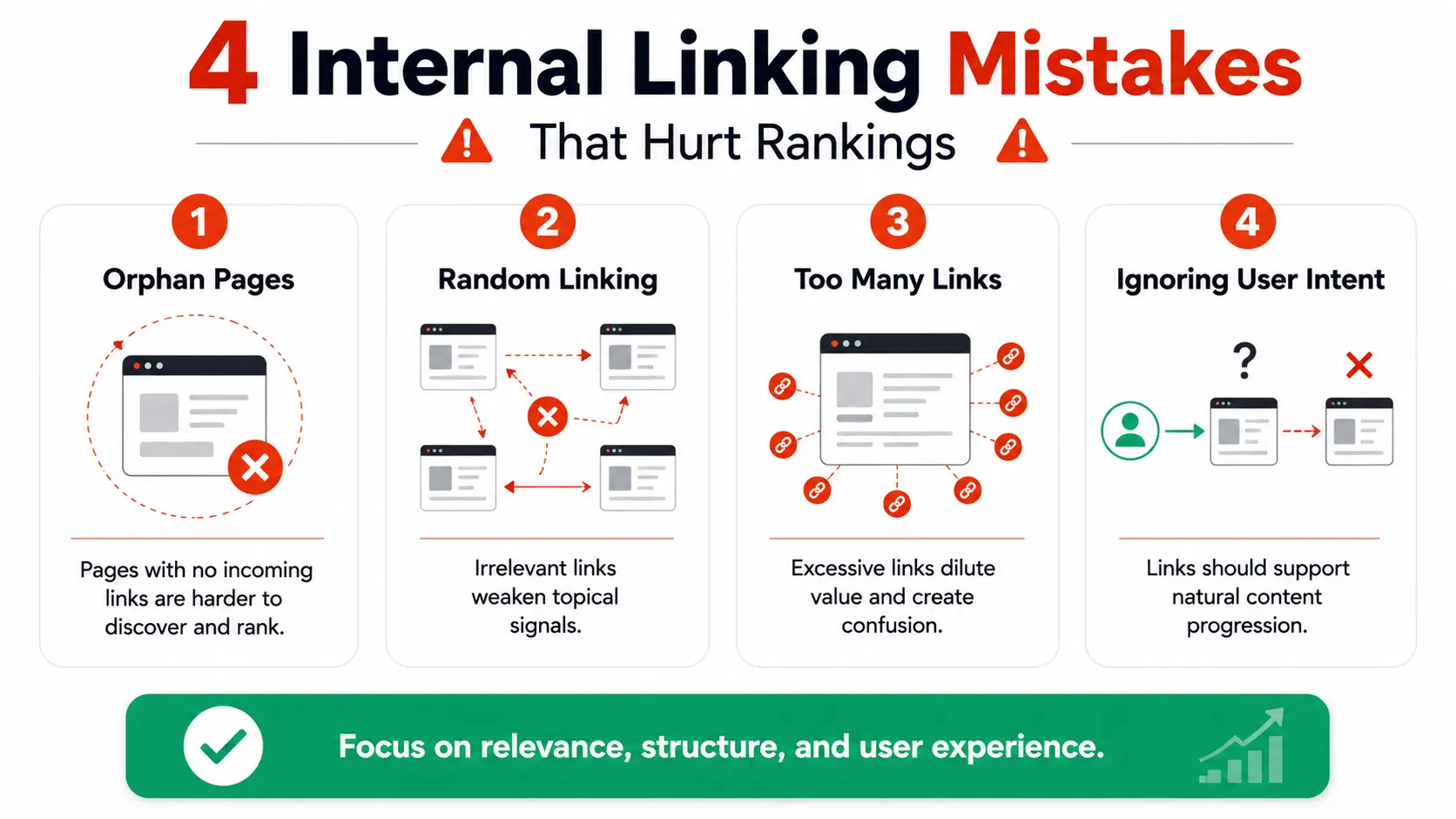
Mistake 2: Orphan Pages
Explain:
Pages with no incoming links.
Consequences:
- weak crawlability
- poor rankings
Mistake 3: Excessive Linking
Explain:
Too many links dilute value.
Mistake 4: Ignoring User Intent
Not every page should link to every other page.
Context matters.
Expert Insight: What Most Internal Linking Advice Gets Wrong
This is your differentiator section
Most SEO advice treats internal linking as a numbers game.
More links.
More anchors.
More optimization.
In practice, successful websites think differently.
They focus on topic reinforcement.
The strongest internal link is not necessarily the one with the perfect anchor text.
It’s the one that helps Google understand why two pieces of content belong together.
That’s why a link from a topical authority article to an internal linking guide is powerful.
The relationship makes sense.
The user journey makes sense.
The topical connection makes sense.
Many websites chase backlinks while ignoring these opportunities.
Yet some of the biggest ranking improvements come from strengthening content relationships that already exist on the site.
Practical Internal Linking Checklist
Before Publishing Any Article
✓ Link to at least one pillar page
✓ Link to at least two related articles
✓ Add contextual anchors naturally
✓ Check for orphan pages
✓ Prioritize relevance over quantity
✓ Support topic clusters
✓ Consider user journey
✓ Update older content with new links
Conclusion
Most websites treat internal linking as a technical task.
Something to clean up later.
The reality is very different.
Internal linking influences how search engines understand your expertise, how authority moves across your site, and how readers discover the content you’ve already worked hard to create.
A well-structured website doesn’t happen because you publish more articles. It happens because those articles support one another.
That’s why the best internal linking strategies aren’t built around keywords alone. They’re built around topics, relationships, and user intent.
If you’re already investing in keyword research, content creation, and topical authority, internal linking is the layer that connects everything together.
Start small. Audit your existing content. Strengthen connections between related topics. Create clear pathways between pillar pages, cluster content, and supporting articles.
Over time, those connections become a competitive advantage that’s difficult for most websites to replicate.



One thought on “Internal Linking Strategy in 2026: The SEO Framework That Helps Content Rank Faster”
Comments are closed.