 by
by Introduction
Most websites don’t have a content creation problem.
They have a content buildup issue.
Blogs accumulate a lot of old articles, duplicate topics, abandoned experiments, and pages that don’t contribute to rankings, traffic, or conversions over time. It’s not simply a cluttered website. Often it’s keyword cannibalization, weaker topical signals, wasted crawl budget and diminishing organic performance.
That’s where SEO content pruning comes into play.
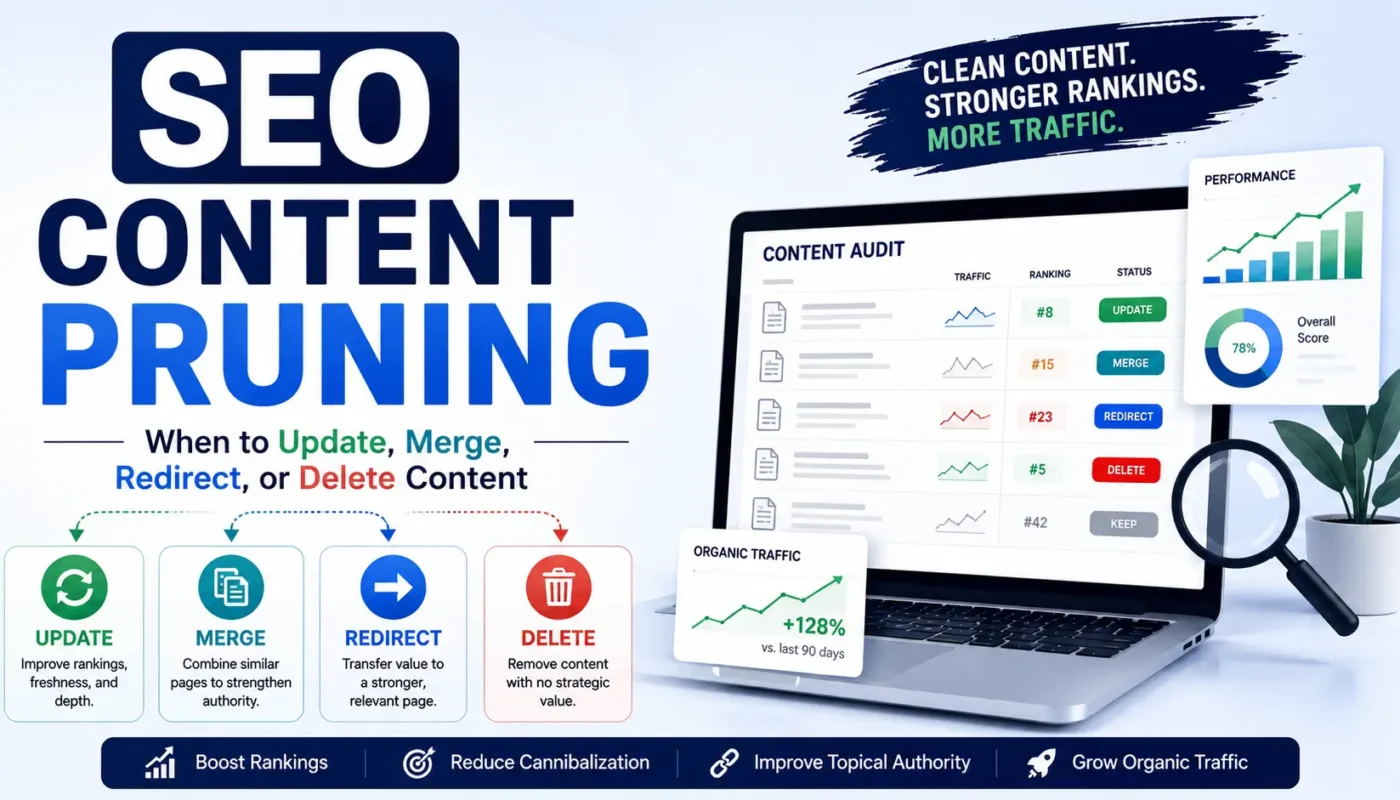
Content pruning is not about deleting pages hard and fast. This is about making strategic decisions around your existing content so that your strongest pages have a better chance of ranking. Sometimes that means updating. Sometimes, it means blending. Sometimes it means removing content altogether.
The challenge is knowing which action to take and when.
This guide explains a practical framework for deciding whether a page should be updated, merged, redirected, or deleted—and how to avoid the costly mistakes that often accompany content pruning projects.
Why Content Pruning Matters More Than Most SEO Advice
Many website owners assume growth comes from publishing more content.
In reality, growth often comes from improving what already exists.
When a site accumulates hundreds of pages over several years, patterns start to emerge:
- Multiple pages targeting nearly identical keywords
- Outdated content losing relevance
- Thin articles with little value
- Pages ranking on page two or three for valuable queries
- Legacy content attracting no traffic or links
Search engines evaluate websites as collections of interconnected resources. Weak content doesn’t always hurt rankings directly, but it often dilutes topical focus and creates unnecessary complexity.
A well-executed content pruning strategy helps:
- Improve topical authority
- Reduce keyword cannibalization
- Strengthen internal linking structures
- Consolidate ranking signals
- Improve user experience
- Increase crawl efficiency
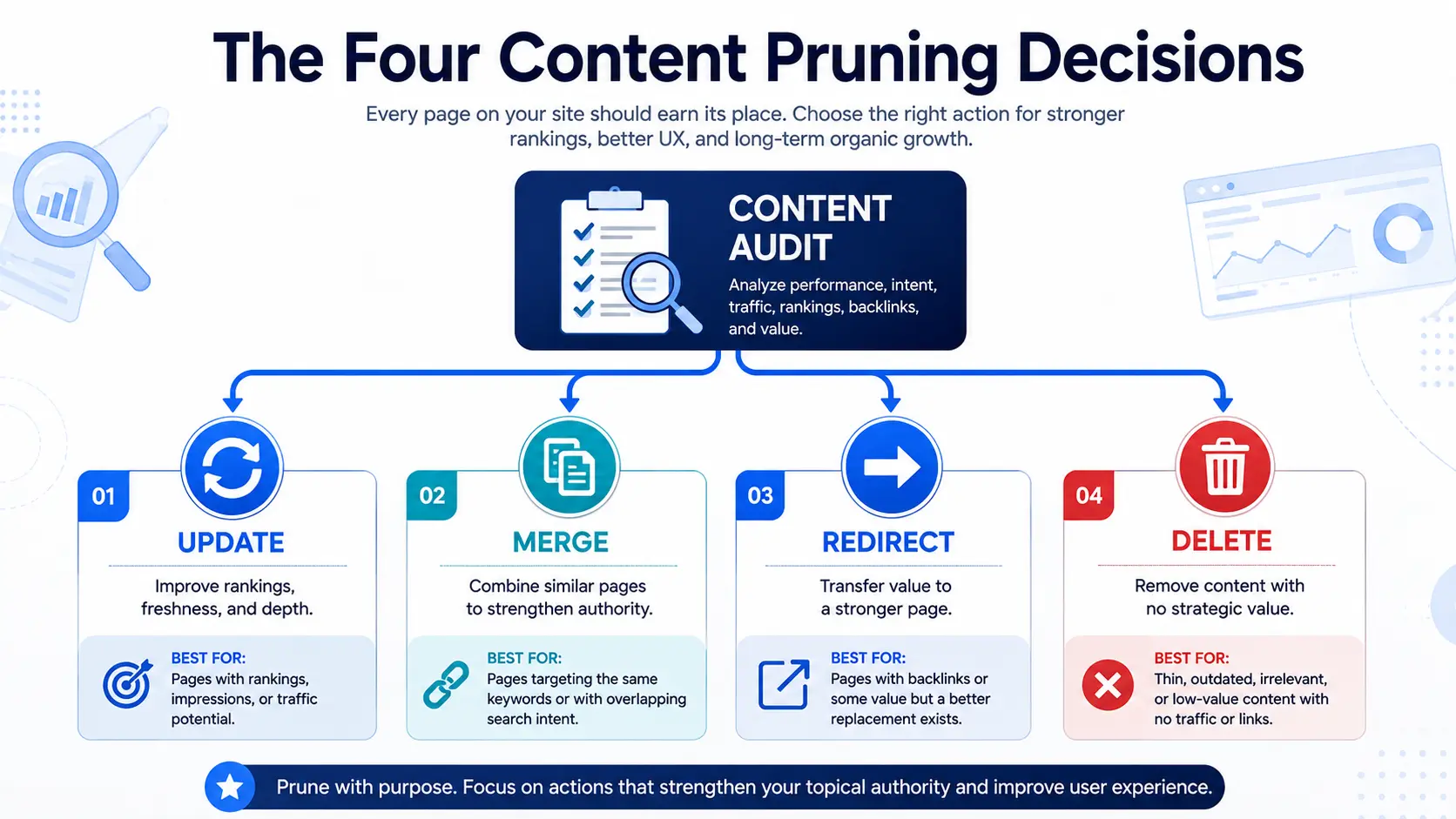
The Four Possible Decisions for Every Page
Before making changes, understand that every page usually falls into one of four categories.
Option 1: Update the Content
The page still has value.
Maybe it ranks in positions 8–20.
Maybe search intent has shifted.
Maybe competitors now provide better answers.
These pages are often the easiest wins.
Update when:
- Rankings exist but have stalled
- Traffic has declined over time
- Information is outdated
- Content lacks depth
- Search intent has evolved
Typical improvements include:
- Expanding coverage
- Improving structure
- Refreshing examples
- Adding internal links
- Enhancing topical completeness
Option 2: Merge Similar Pages
This is one of the most overlooked SEO opportunities.
Many sites accidentally create multiple articles targeting closely related topics.
Examples:
- Internal Linking Guide
- Internal Linking Tips
- Internal Linking Best Practices
Instead of ranking separately, these pages often compete against each other.
Merging allows ranking signals to consolidate into one stronger resource.
Merge pages when:
- Search intent overlaps significantly
- Keyword targets are nearly identical
- Multiple pages rank poorly
- Content duplication exists
After merging, implement proper redirects to preserve authority.
Option 3: Redirect the Page
Some pages no longer deserve to exist independently but still have value.
Perhaps they have backlinks.
Perhaps they receive occasional traffic.
Perhaps another page now covers the topic better.
In these situations, redirecting usually makes more sense than deleting.
Redirect when:
- A stronger replacement page exists
- Similar content already ranks
- Historical backlinks exist
- The page has limited standalone value
The goal is preserving equity rather than abandoning it.
Option 4: Delete the Content
Deletion should be the final option, not the first.
Some content genuinely provides no value.
Examples include:
- Thin pages
- Obsolete announcements
- Expired event content
- Low-quality AI-generated articles
- Pages with no traffic, links, or strategic purpose
Delete only after confirming:
- No meaningful backlinks exist
- No valuable traffic exists
- No strategic relevance remains
Deletion without analysis is one of the fastest ways to damage a site’s long-term growth.
A Practical Content Pruning Workflow
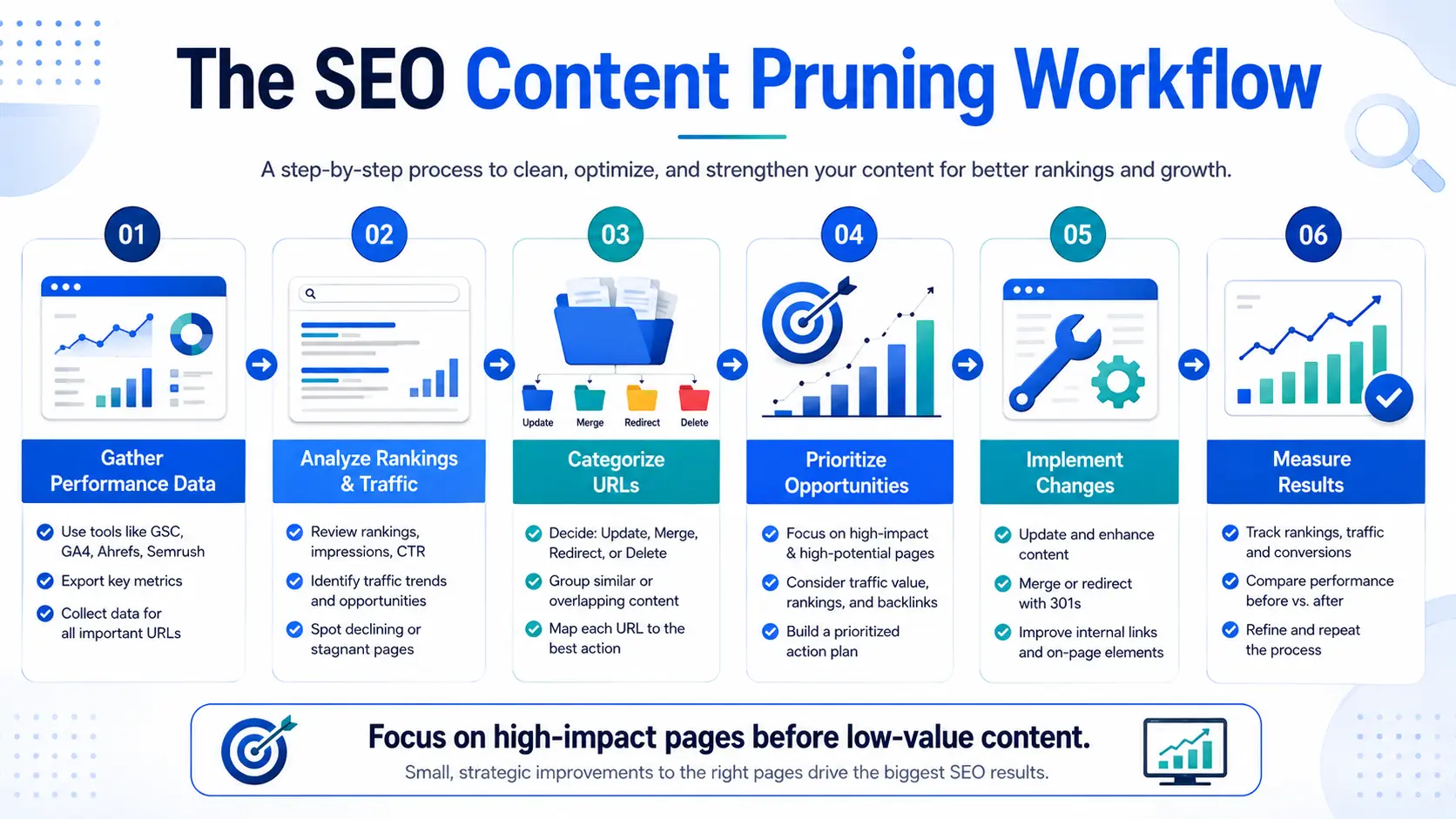
The process works best when approached systematically.
Step 1: Gather Performance Data
Review:
- Organic traffic
- Rankings
- Click-through rates
- Backlinks
- Internal links
- Conversion performance
Tools commonly used include:
- Google Search Console
- Google Analytics
- Ahrefs
- Semrush
- Screaming Frog
Each tool solves a different problem. Search Console often identifies opportunities. Crawling tools reveal structural issues.
Step 2: Categorize Every URL
Create four categories:
- Update
- Merge
- Redirect
- Delete
Avoid making decisions page by page emotionally.
Work from data.
Patterns become obvious surprisingly quickly.
Step 3: Prioritize by Impact
Not every page deserves attention immediately.
Focus first on:
- High impressions, low CTR pages
- Pages ranking positions 5–20
- Cannibalized content
- Important commercial pages
These typically produce faster results than fixing dozens of low-value pages.
Step 4: Implement Changes Carefully
Document everything.
Track:
- Original URLs
- Redirect targets
- Merge decisions
- Updated publication dates
Poor documentation becomes a major problem six months later.
What Most Websites Get Wrong
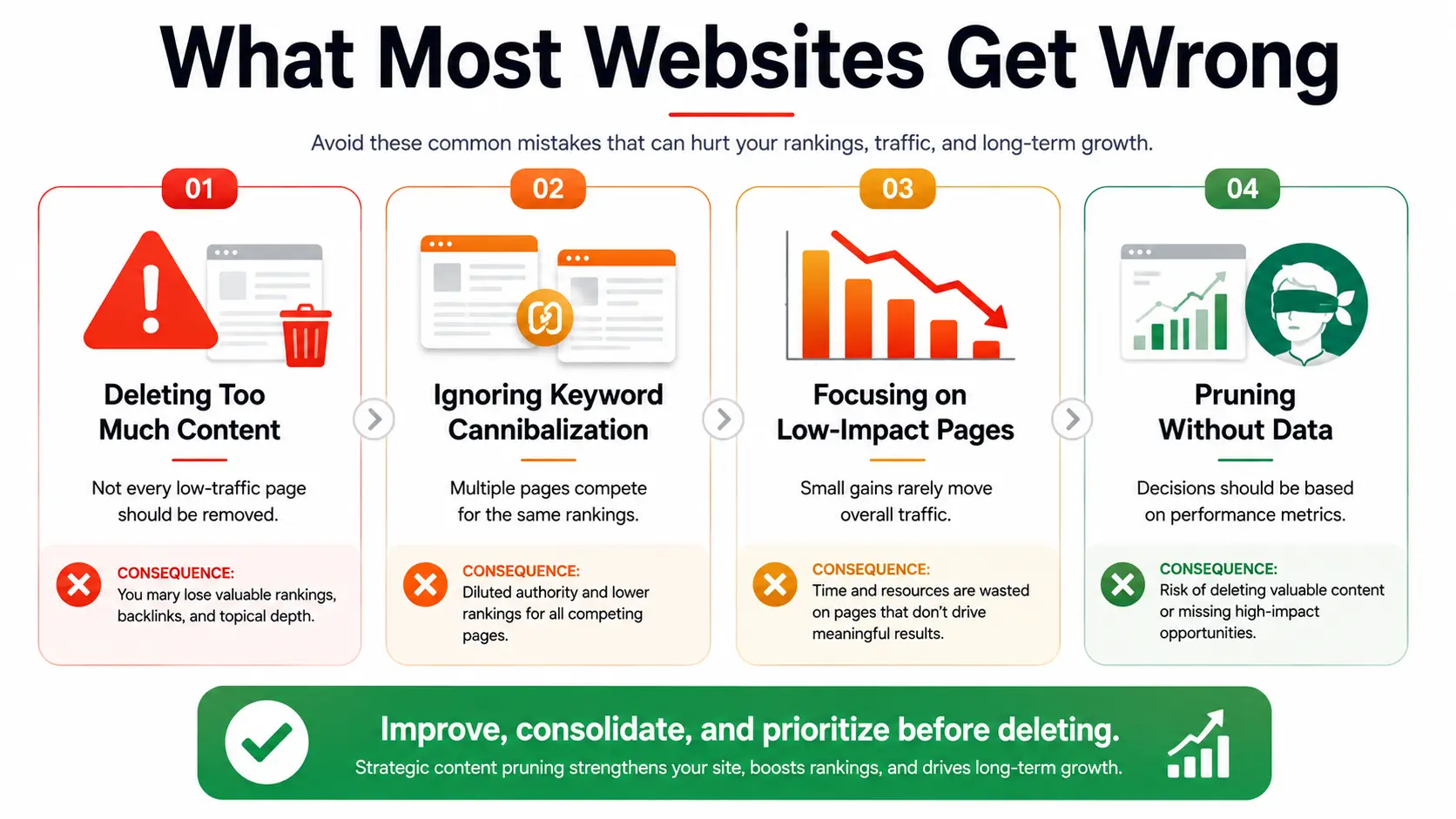
The biggest misconception is that content pruning means deleting content.
In practice, deletion is usually the smallest part of the process.
Most ranking improvements come from consolidation and enhancement.
Another common mistake is focusing on low-traffic pages.
Experienced SEOs often prioritize pages already showing ranking potential. A page sitting in position 11 can produce more value than fifty pages generating zero impressions.
Many website owners also underestimate keyword cannibalization.
Two average pages targeting the same intent rarely outperform one exceptional page.
Finally, teams often try to prune everything at once.
Large-scale content audits create massive task lists. The better approach is identifying leverage points first.
Fix the pages closest to success.
Then work outward.
That sequence usually delivers significantly better ROI.
Choosing the Right SEO Tools for Content Pruning
For smaller websites:
- Google Search Console
- Google Analytics
- Screaming Frog
For growing sites:
- Ahrefs
- Semrush
- Surfer SEO
For large content libraries:
- Screaming Frog
- Ahrefs Site Audit
- Semrush Content Audit
The best tool isn’t necessarily the most expensive.
The best tool is the one that helps you identify opportunities quickly and take action consistently.
Conclusion
Sometimes the answer isn’t more content.
Many websites already have enough content to generate a lot more traffic than they are getting. But the issue is that valuable opportunities are still hidden under old articles, overlapping topics and dormant pages.
Content pruning is how you find those opportunities.
Done right, it tightens topical focus, strengthens ranking signals, improves user experience, and makes your existing content work harder.
The goal isn’t to have less pages.
The aim is to have better pages.
Before you write your next article, take time to evaluate the articles you have already published. In many cases, the quickest way to more organic traffic isn’t about adding content. It’s about improving the content you already have access to.