
Introduction
A lot of sites don’t have a content problem. They have a visibility problem.
Here’s what that actually looks like in practice: I recently pulled Search Console data on a page that was attracting over 5,500 impressions across ten different query variations — “seo content audit,” “content audit seo,” “seo content audits,” and others — with one query alone bringing in 3,500+ impressions. The page was indexed, Google understood exactly what it was about, and it was getting found for the right searches.
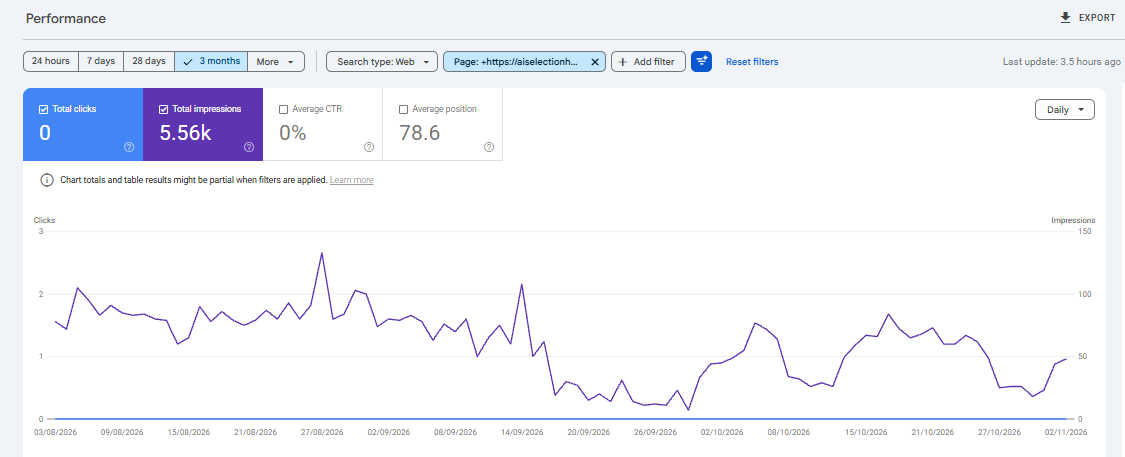
It had zero clicks. Not low clicks — zero, across every single query. The average position was 78.
That’s not a content-quality problem you can fix with a better meta description. It’s exactly the kind of hidden ranking opportunity a proper SEO content audit is built to catch — and it’s why more publishing doesn’t always equal better rankings. Eventually, growth stops being about creating new articles and starts being about improving the content you already have.
Instead of asking “what should we publish next,” a content audit asks a more valuable question: what ranking opportunities are we already sitting on?
What Is an SEO Content Audit?
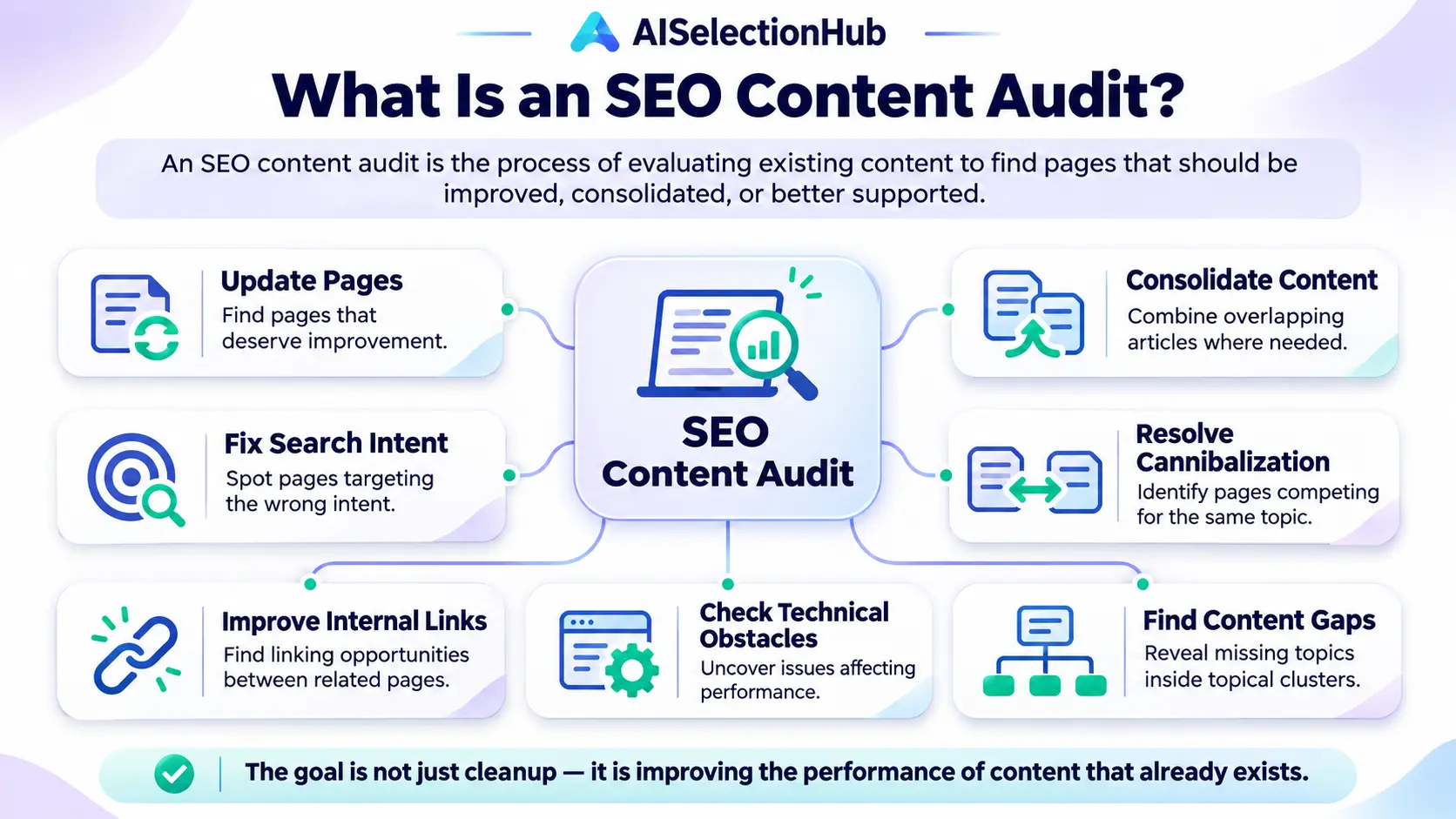
An SEO content audit is the process of evaluating existing content to identify:
- Pages that deserve updates
- Content that should be consolidated
- Articles targeting the wrong search intent
- Keyword cannibalization issues
- Internal linking opportunities
- Technical obstacles affecting performance
- Content gaps within topical clusters
The objective isn’t simply to clean up old content. The objective is to increase the performance of assets that already exist.
Why SEO Content Audits Matter More Than Most People Think
Many site owners assume growth comes from publishing more articles. In practice, some of the largest ranking gains come from improving content Google already understands but isn’t yet ranking well — like a page sitting on impressions with no clicks to show for it.
A content audit can help you:
- Increase rankings without publishing new content
- Recover declining traffic
- Strengthen topical authority
- Improve crawl efficiency
- Enhance user experience
- Uncover hidden keyword opportunities
This becomes even more important once you’re actively building topical authority across a specific niche.
Signs Your Website Needs a Content Audit
- Traffic has plateaued
- Impressions are increasing but clicks remain flat or at zero
- Multiple articles target similar topics
- Older content contains outdated information
- Important pages receive few internal links
- Pages rank on page two, three, or further for valuable keywords
If any of these sound familiar, the opportunity isn’t in your next article — it’s already live on your site.
The SEO Content Audit Framework
Step 1: Create a Complete Content Inventory
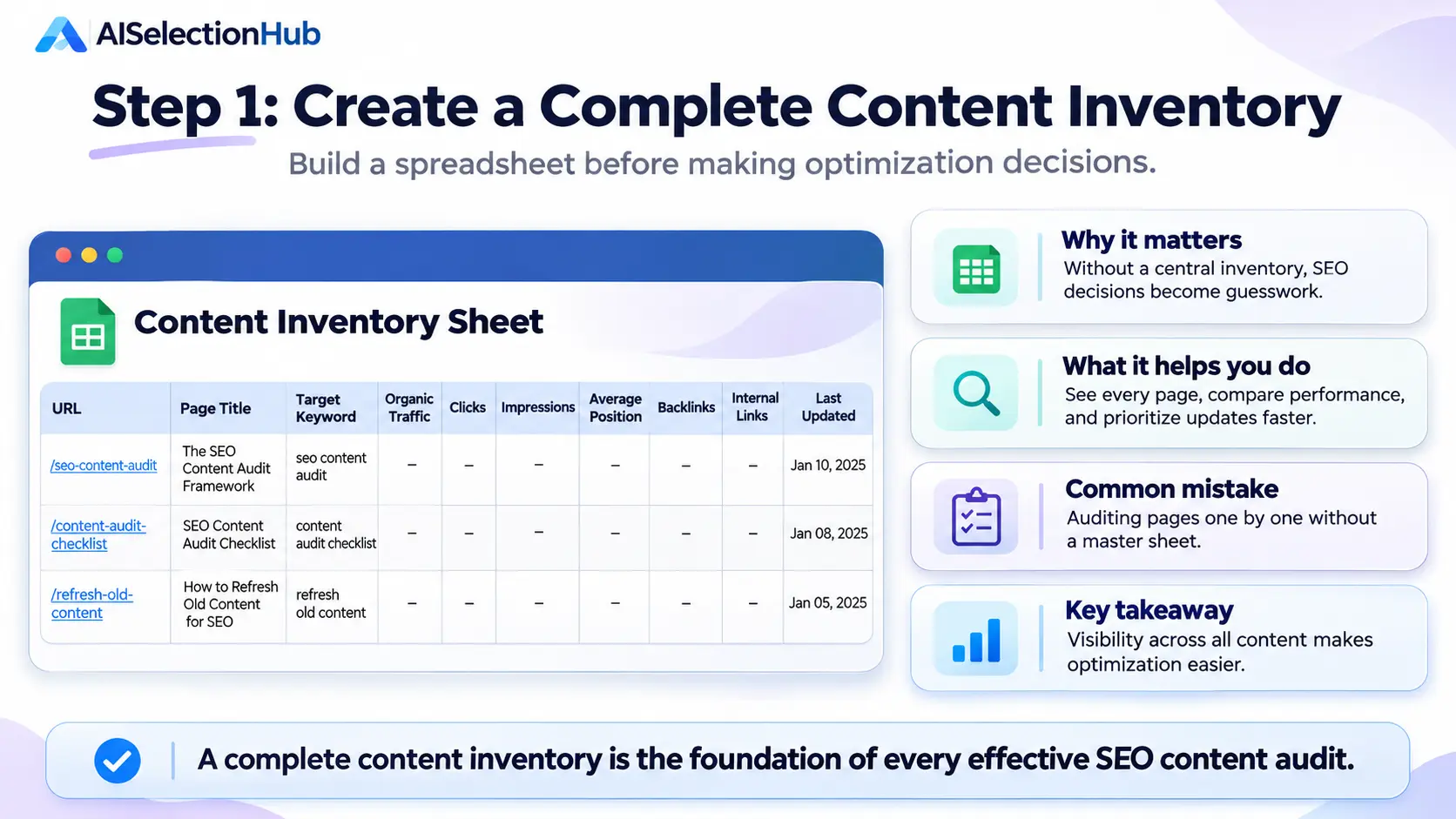
Start with a spreadsheet. Document:
- URL
- Page title
- Target keyword
- Organic traffic
- Clicks
- Impressions
- Average position
- Backlinks
- Internal links
- Last updated date
Most websites underestimate how difficult it becomes to prioritize optimization work when there’s no central inventory. Without visibility across every page, prioritization becomes guesswork.
Step 2: Find Your Hidden Winners
Not all underperforming pages are weak pages. Some are simply under-optimized or under-supported. Look for:
- Keywords ranking positions 8–20
- High impressions but low or zero CTR
- Growing impression trends
- Pages attracting relevant traffic but stuck below page one
These often represent the fastest SEO wins. A page ranking #11 can sometimes reach page one with relatively small improvements — but a page ranking in the 70s or 80s, like the example above, usually needs a different kind of fix: stronger structure, stronger internal links, and stronger proof of expertise, not just a tweaked title tag.
Step 3: Identify Keyword Cannibalization
One of the most common ranking problems appears when multiple pages compete for the same topic. Examples:
- Best SEO Tools
- SEO Tools for Beginners
- SEO Tools for Small Businesses
If keyword targeting overlaps excessively, Google can struggle to determine which page should rank, and both pages can end up weaker than if only one existed. For a full walkthrough of finding and fixing this using Search Console, see our keyword cannibalization guide
The solution isn’t always deletion. Sometimes differentiation solves the problem. Sometimes consolidation is necessary — covered in Step 8 below.
Step 4: Review Search Intent Alignment
Many pages fail because they satisfy the wrong intent. A keyword may appear informational on the surface, but the actual search results may reveal commercial intent, or vice versa.
Before updating content, compare your page against what’s currently ranking. Ask:
- What content format dominates the top results?
- Are users looking for guides, reviews, comparisons, or tutorials?
- Does your page match that format, or fight against it?
Intent mismatches suppress rankings even when the content quality itself is strong.
Step 5: Audit Internal Linking
Internal links are one of the most overlooked ranking signals available to site owners. Look for:
- Orphan pages with no internal links pointing to them
- Weakly connected content sitting outside your main clusters
- Missing contextual links inside relevant paragraphs
- Broken internal paths
A deeper breakdown of this strategy is covered in our Internal Linking Strategy guide. Strong internal linking helps search engines understand relationships between pages while distributing authority across topical clusters — and it works both ways: a page needs links pointing to it, not just links pointing out.
Step 6: Evaluate On-Page SEO Elements
Review:
- Title tags
- Meta descriptions
- H1 tags and header hierarchy (every section should use a real H2/H3, not bolded text)
- Image optimization and alt text
- Schema markup
- Content freshness
Most websites focus on content quantity while ignoring basic optimization elements like these. Small improvements here often compound over time, and they cost nothing to fix.
Step 7: Analyze Topical Coverage
This stage separates advanced audits from basic ones. Instead of analyzing individual pages, evaluate coverage across the whole topic. Ask:
- Which subtopics are missing?
- Which questions remain unanswered?
- Which supporting articles are absent?
For example, a topical authority cluster around keyword research might include keyword research tools, search intent, keyword clustering, competitor analysis, and content planning. Missing supporting topics can limit the ranking potential of the entire cluster, not just the page you’re auditing.
Step 8: Decide What Happens Next
Every page should receive one of four decisions:
- Keep — the page performs well as-is
- Update — the page has ranking potential but needs improvement
- Merge — multiple pages overlap excessively and should be combined
- Remove or Redirect — the content provides little value and serves no strategic purpose
For a full breakdown of exactly how to execute merge, redirect, and removal decisions, see our content pruning guide.
A Faster Win: Target the Long-Tail Variant Directly
While you work on the fixes above, add a short, clearly-answered subsection inside the page targeting a lower-competition variant of your main term — for example, directly answering “how to perform an SEO content audit” in a concise, numbered format. These longer, more specific queries carry far less competition than the head term and can realistically reach page one while the main keyword climbs over time.
What Most Websites Get Wrong
Most audits focus on pages. The strongest audits focus on systems.
Google increasingly evaluates expertise through content ecosystems rather than isolated articles. Many site owners obsess over word count, publishing frequency, and keyword density, while ignoring content relationships, topic coverage, internal linking architecture, and search intent consistency.
A website with 40 strategically connected articles often outperforms a website with 100 disconnected ones.
Another mistake is treating every page equally. Not every article deserves updates — prioritize pages closest to a meaningful ranking gain. The goal isn’t to improve everything. The goal is to improve the right things first.
Recommended SEO Content Audit Tools
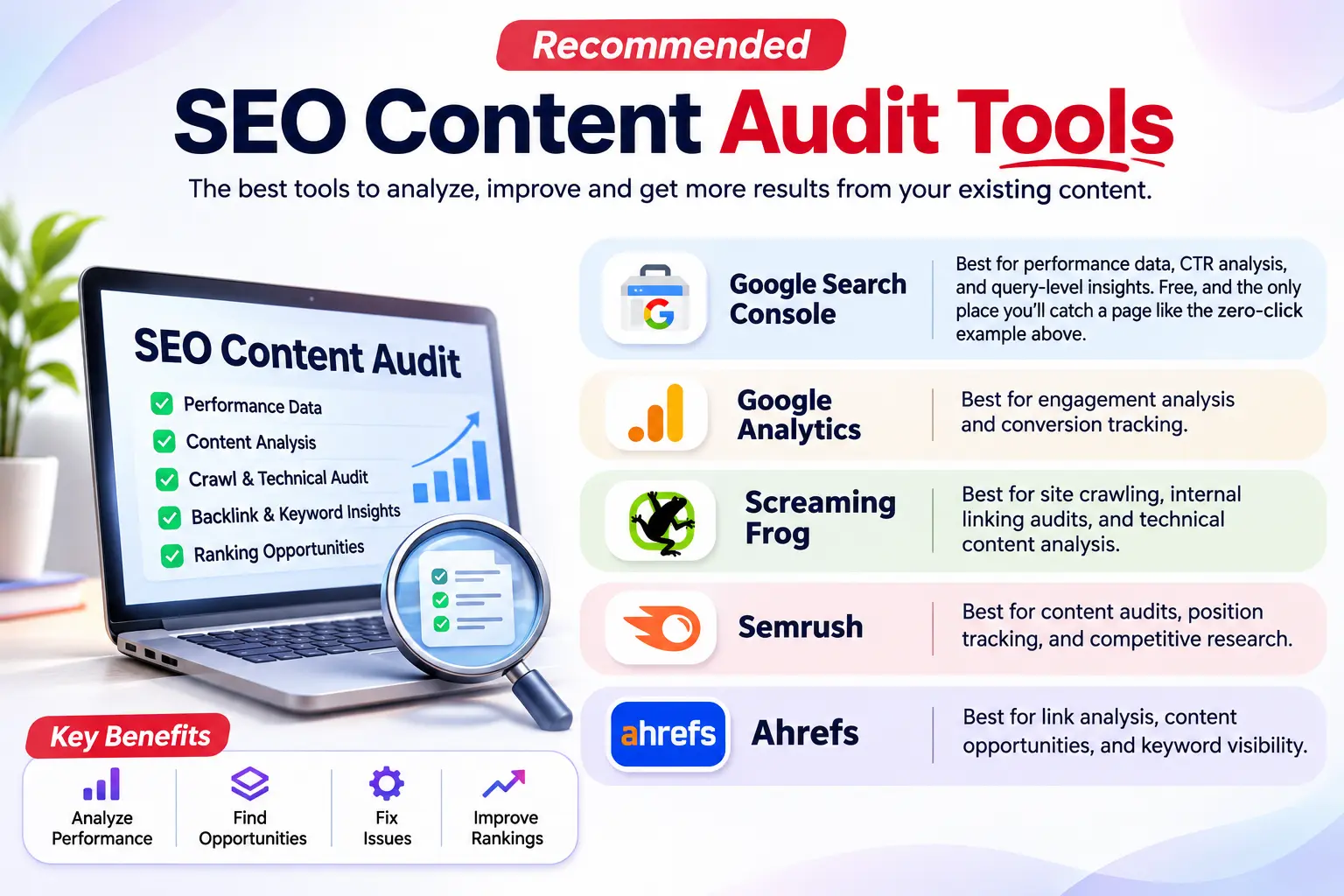
Google Search Console — Best for performance data, CTR analysis, and query-level insights. Free, and the only place you’ll catch a page like the zero-click example above.
Google Analytics — Best for engagement analysis and conversion tracking.
Screaming Frog — Best for site crawling, internal linking audits, and technical content analysis.
Semrush — Best for content audits, position tracking, and competitive research.
Ahrefs — Best for link analysis, content opportunities, and keyword visibility.
A Practical Audit Workflow for Small Websites
Monthly
- Review Search Console
- Identify declining pages
- Find CTR and ranking opportunities
Quarterly
- Run a full content inventory review
- Audit internal links
- Evaluate topical coverage
Every Six Months
- Refresh high-value content
- Merge overlapping pages
- Update outdated statistics and examples
This cadence stays manageable while continuously improving rankings.
Conclusion
On most websites, the biggest ranking opportunities aren’t in future content ideas. They’re buried in content that’s already there — sometimes literally sitting at position 78 with thousands of impressions and nothing to show for it.
A good SEO content audit helps you identify pages that need attention, fix the weaknesses preventing them from ranking, and build stronger connections between the content on your site. Publishing new articles will always matter. But over the long term, SEO growth comes down to optimizing what you’ve already built — and the sites that keep growing are the ones that constantly assess, refine, and strengthen their existing content ecosystem.
3 thoughts on “SEO Content Audit: The Complete Guide for Finding Hidden Ranking Opportunities”
Comments are closed.