 by
by You write article after article, optimize your pages and maybe even build a few backlinks – but your website still struggles to consistently rank.
Competitors, meanwhile, seem to get visibility for dozens of related keywords, even when their individual articles don’t look much better.
Often the difference is topical authority.
Google no longer assesses content in isolation. It checks if your website demonstrates true expertise in an entire subject area. A site with 30 quality, relevant posts that are well connected internally can easily outrank a site with 100 random posts targeting unrelated keywords.
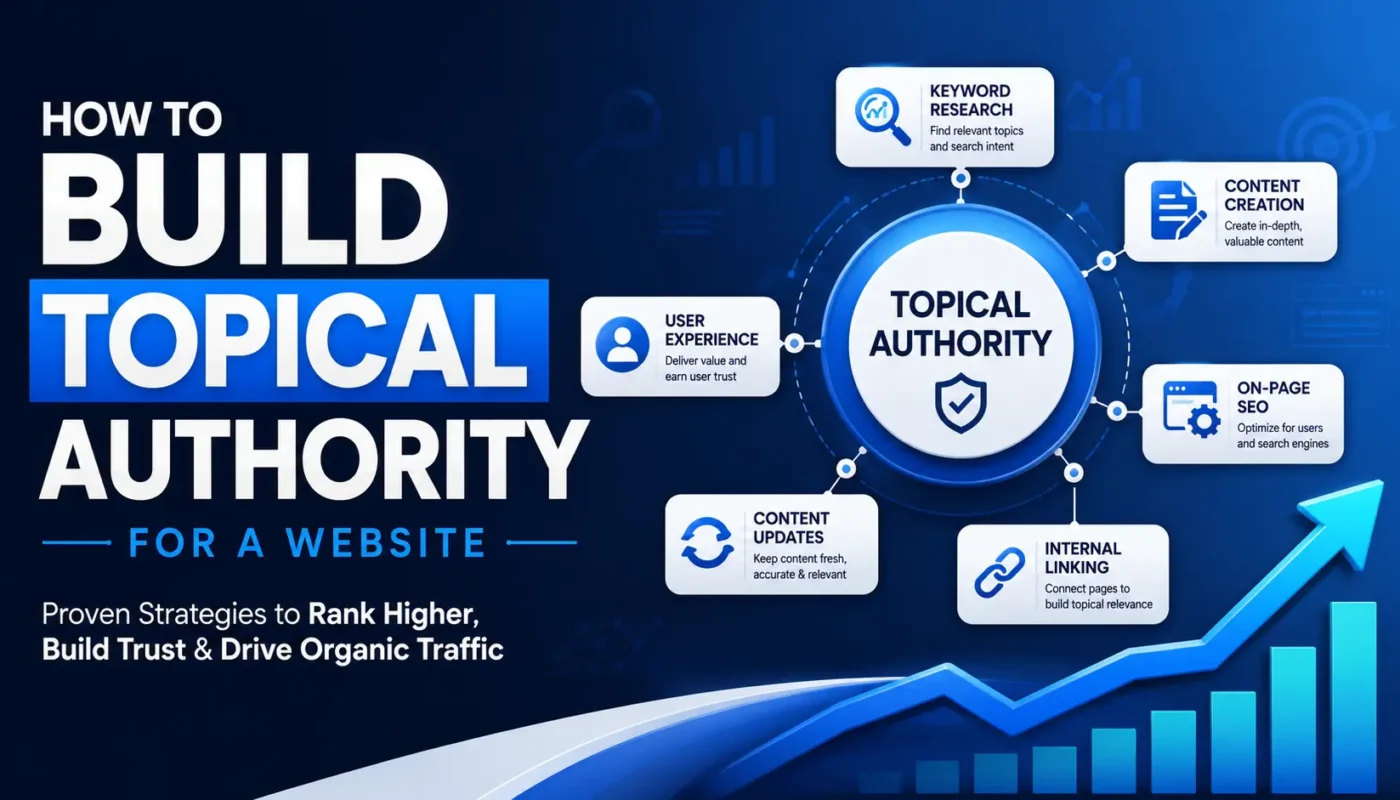
In this guide, you’ll learn how to build topical authority for a website, how to create a sustainable topical authority SEO strategy, and how to turn your content into a resource that search engines trust and users keep coming back to.
What Is Topical Authority?
Topical authority is Google’s confidence that your website understands a specific subject better than most alternatives.
Think about websites that dominate their categories.
When people think about SEO education, names like Ahrefs, Semrush, and Backlinko often come to mind. Not because they wrote one successful article about SEO, but because they created hundreds of interconnected resources covering nearly every important aspect of the topic.
Google sees patterns.
When a website consistently publishes useful content around a tightly related subject, it becomes easier for search engines to trust that website on future content within the same area.
This is why a new article from an established SEO website often ranks faster than an identical article published on a brand-new site.
The article isn’t necessarily better.
The site’s topical authority is stronger.
The Biggest Misunderstanding About Topical Authority SEO
Many people believe topical authority means covering every keyword in a niche.
That approach usually leads to burnout and mediocre content.
Instead, topical authority is about depth before breadth.
For example, if your website focuses on SEO, you don’t need to cover every marketing topic immediately.
A more effective approach might look like:
- Keyword research
- Content strategy
- On-page SEO
- Internal linking
- Content optimization
Once you’ve established expertise in those areas, expanding becomes much easier.
The mistake is trying to become an authority on everything before becoming an authority on anything.
Why Topical Authority Matters More Than Ever
A few years ago, websites could rank by targeting isolated keywords and building backlinks aggressively.
The landscape has changed.
Google now evaluates content in a broader context.
Instead of asking:
“Is this article relevant?”
Search engines increasingly ask:
“Is this website qualified to talk about this topic?”
That’s a fundamentally different evaluation.
It rewards specialization.
And it explains why some newer websites with excellent content still struggle to rank.
Their expertise isn’t yet obvious at the site level.
Step 1: Choose a Topic You Can Actually Cover Deeply
This sounds obvious.
Yet many websites fail here.
A topic like “digital marketing” is usually too broad for a growing website.
A topic like “SEO content strategy” is far more manageable.
The goal is to find an area where you can realistically create dozens of valuable articles over time.
Ask yourself:
- Can I publish 30 quality articles on this topic?
- Can I answer beginner questions?
- Can I answer advanced questions?
- Can I cover tools, strategies, workflows, and mistakes?
If the answer is yes, you’ve probably found a viable topic.
Step 2: Build a Topical Map Before Writing
One of the biggest productivity killers in SEO is publishing without a roadmap.
Many website owners discover keywords one by one and create content reactively.
A topical map changes that.
Instead of thinking in individual articles, you think in connected subjects.
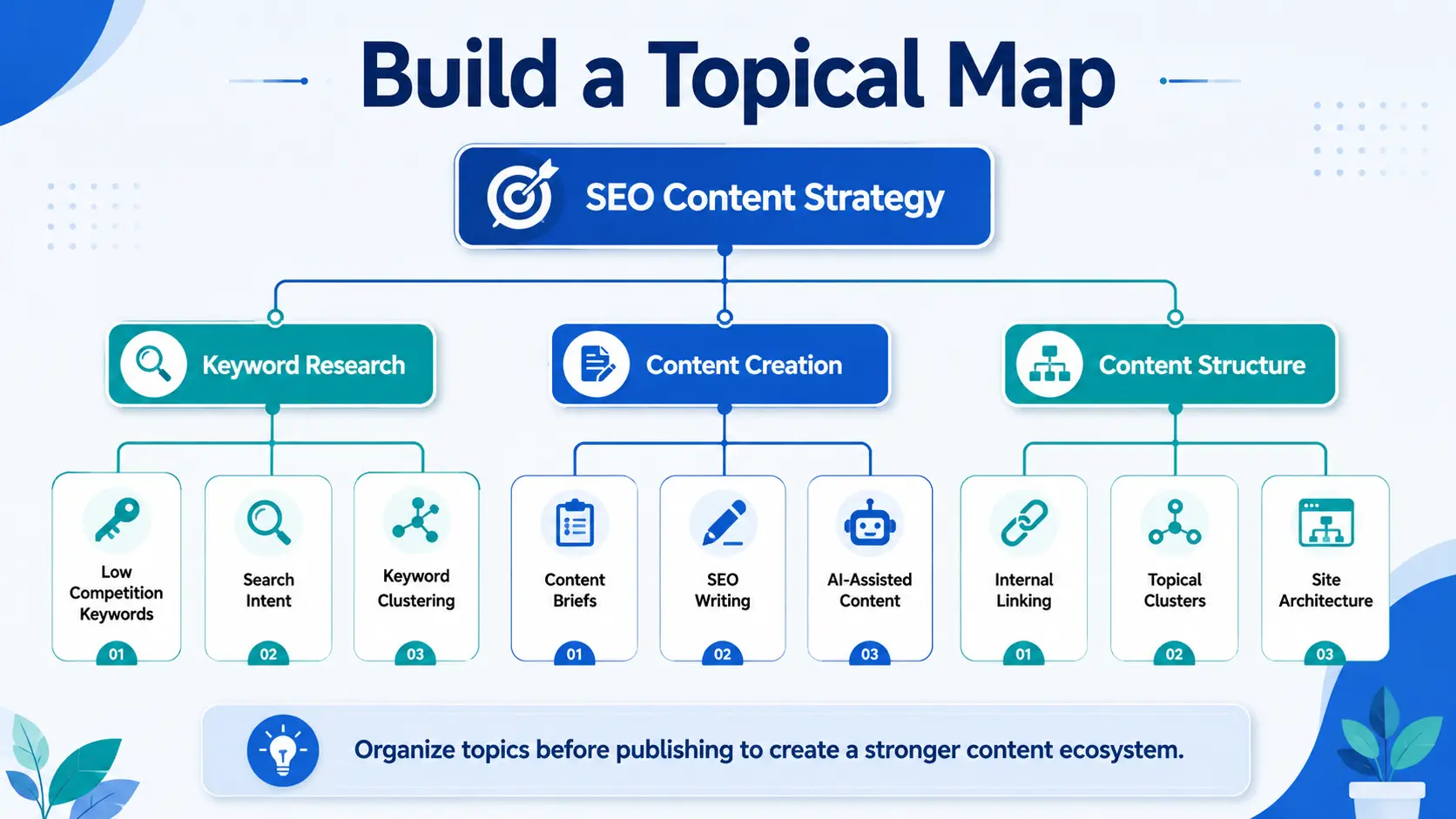
For example, a website focused on SEO content strategy might organize topics like this:
Keyword Research
- Low competition keywords
- Search intent
- Keyword clustering
- Keyword difficulty
Content Creation
- Content briefs
- SEO writing
- Content optimization
- AI-assisted content
Content Structure
- Internal linking
- Topical clusters
- Content silos
- Site architecture
This creates a logical content ecosystem.
If you’re still identifying opportunities, this guide on finding low-competition keywords can help uncover topics that are easier to rank for early on:
https://aiselectionhub.com/how-to-find-low-competition-keywords/
Step 3: Create Content Clusters Instead of Random Articles
This is where many topical authority websites separate themselves from average blogs.
Random articles rarely create momentum.
Clusters do.
Imagine publishing:
- How to Build Topical Authority
- Internal Linking Strategy
- Topical Maps Explained
- Content Silos vs Topic Clusters
- SEO Content Planning Framework
Each article strengthens the others.
Google starts seeing relationships.
Users explore multiple pages.
Session depth increases.
Trust grows.
Topical authority isn’t built through isolated wins.
It’s built through connected relevance.
Step 4: Make Internal Linking a Strategic Asset
Internal linking is often treated as an afterthought.
It shouldn’t be.
Good internal links help Google understand:
- Which pages are most important
- How topics connect
- Which content supports broader themes
Poor internal linking leaves valuable content isolated.
When discussing content production workflows, for example, it makes sense to connect readers with a proven SEO content writing framework:
https://aiselectionhub.com/seo-content-writing-framework/
The link serves a purpose.
It extends the user’s journey.
That’s the standard every internal link should meet.
Step 5: Cover the Entire Search Journey
Most websites only target one stage of user awareness.
Topical authority websites cover all stages.
Consider someone learning SEO.
Their journey might look like this:
Beginning:
- What is SEO?
- How does Google rank websites?
Intermediate:
- Keyword research
- On-page optimization
- Internal linking
Advanced:
- Topical authority
- Semantic SEO
- Content scaling
If your website only serves advanced users, you’re missing a large audience.
If it only serves beginners, growth eventually stalls.
Authority grows when you support users throughout their learning journey.
The Hidden Advantage of Updating Existing Content
Many site owners obsess over publishing new articles.
Meanwhile, some of their best ranking opportunities already exist.
Updating content can be one of the fastest ways to strengthen topical authority.
When updating content:
- Add new examples
- Improve internal linking
- Expand weak sections
- Refresh screenshots
- Include recent industry developments
A website with 40 excellent articles often outperforms a website with 150 neglected articles.
Quality compounds.
Neglect accumulates.
Common Mistakes That Prevent Websites From Building Topical Authority
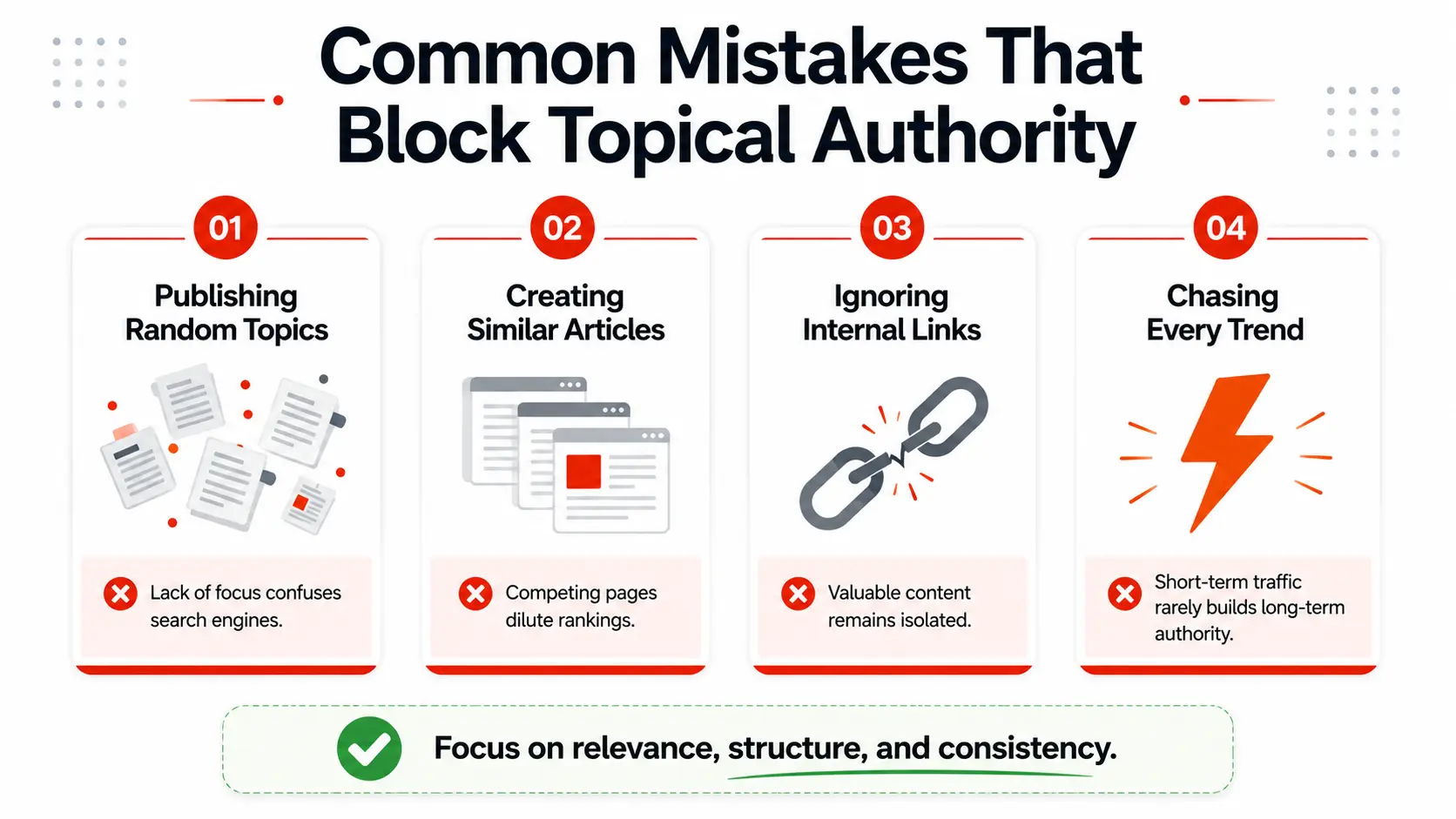
Publishing Whatever Has Search Volume
Search volume can be misleading.
A keyword might look attractive but contribute nothing to your overall topic.
Traffic without relevance rarely builds authority.
Creating Too Many Similar Articles
This is one of the most common SEO mistakes.
Publishing multiple articles targeting nearly identical intent can dilute rankings and confuse search engines.
A deeper discussion of ranking issues caused by content decisions is covered in this guide on SEO mistakes to avoid:
https://aiselectionhub.com/seo-mistakes-to-avoid-2026/
Ignoring Internal Links
Great content becomes invisible when nothing points to it.
Authority flows through connections.
Without those connections, content often remains isolated.
Chasing Trends Constantly
Trending topics can generate short-term traffic.
But topical authority comes from consistency.
The websites that win long term usually spend years reinforcing the same expertise area.
What Most SEO Blogs Fail to Explain
Here’s the uncomfortable truth.
Topical authority is not a tactic.
It’s a byproduct.
You can’t directly optimize for it.
You earn it.
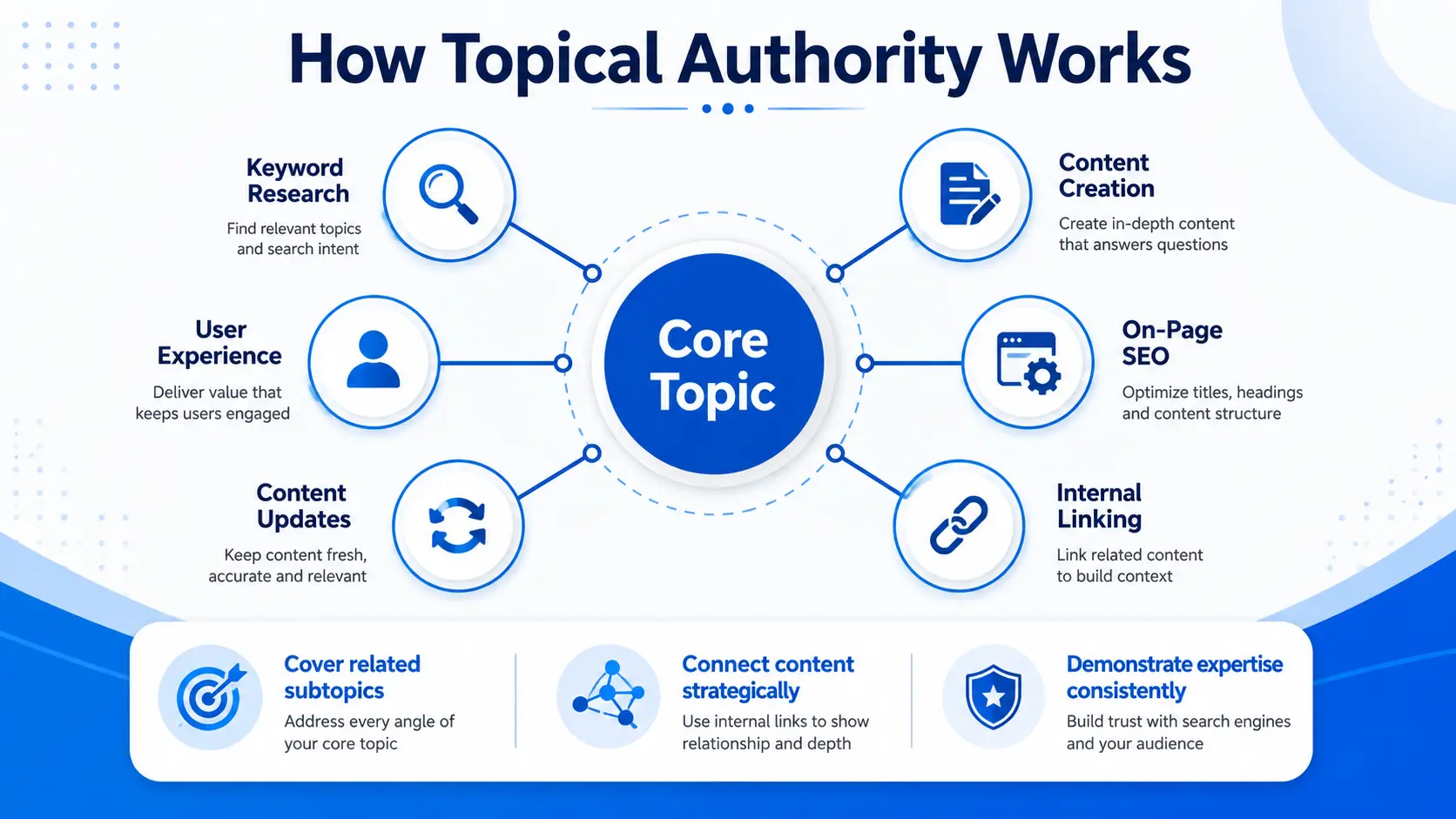
You earn it by repeatedly demonstrating expertise through content quality, content depth, content organization, and user satisfaction.
Many SEO discussions reduce topical authority to checklists.
Create clusters.
Add links.
Publish more content.
Those actions help.
But authority emerges when all those pieces work together.
The framework matters.
The execution matters more.
How Long Does It Take to Build Topical Authority?
Longer than most people expect.
Shorter than most people fear.
For newer websites, meaningful signals often begin appearing after 20–50 highly related articles supported by strong internal linking and consistent updates.
The timeline varies depending on:
- Competition level
- Content quality
- Site age
- Link profile
- Topic complexity
The key is understanding that topical authority compounds.
The first 10 articles often feel slow.
The next 20 become easier.
The next 30 can produce disproportionate growth.
That’s why persistence matters.
Maintaining Topical Authority Over Time
Getting topical authority is hard.
Often even harder is maintaining it.
Many sites build a great cluster of content, get rankings, and then stop improving those pages. Over time, your competitors will publish better resources. Industry information will change. Content that was useful will become outdated.
Topical authority is not a one-time thing. It’s a continuous signal that has to be repeated
The sites that do maintain authority usually follow a simple cycle:
- Update existing content regularly
- Add new supporting articles when topics evolve
- Strengthen internal links between related pages
- Remove or improve outdated information
- Expand successful content based on user search behavior
Think of your content ecosystem as a living asset rather than a finished project.
For instance, a website on SEO in 2026 should not use content written two years ago without updates. It’s not necessarily historical expertise, but current expertise – search engines want to see proof.
A practical approach is to review your most important content every 3-6 months. Small wins like adding new examples, improving internal linking, or updating recommendations can help keep your relevance intact and reinforce your site’s authority signals.
It’s not about making more content.
The aim is to be one of the most useful and up-to-date resources in your chosen topic.
Topical Authority vs Domain Authority
The two are often confused, but they are measuring very different things.
In general, domain authority is a term used to describe how powerful and trustworthy a website is overall, and this can be affected by things like backlinks, brand recognition, and trust signals.
Topical authority refers to expertise in a given subject matter.
A site may have strong domain authority but weak topical authority on a specific topic.
For example, a large news website might have thousands of backlinks and a powerful domain. But a niche SEO website can still outrank it on many SEO related searches because its content will show more expertise and cover the topic more exhaustively.
But a newer site with relatively few backlinks can sometimes compete surprisingly well when it creates comprehensive, interlinked content around a focused subject.
The best SEO strategy uses both of these.
Domain authority helps search engines trust your site.
Topical authority builds trust with search engines in your expertise on a specific topic.
If you have to pick where to focus early on, most growing websites benefit more from building topical authority first. It’s usually easier to build a clear area of expertise than a large backlink profile, and it’s a much better foundation for long-term organic growth.
Final Thoughts
The biggest mistake of website owners is to treat SEO as a set of individual articles.
Here they will publish a keyword, there a comparison post and a few trend-driven topics when they see search volume. The final result is usually a website with a lot of content and very little authority.
Building topical authority is different.
It is the result of repeatedly helping people to solve problems in a certain subject area. Each article, internal link, content update, and supporting resource sends a signal about what your website truly specializes in.
The good news is that you don’t have to have hundreds of articles to get started. You need a well defined topic, a well thought out content structure and the patience to build depth before going for breadth.
The first is to be the best resource on one topic before moving on to the next. Publish content that answers genuine queries Link your pages wisely Keep improving whatever you’ve published.
Google slowly starts to look at your website in a different light. More importantly, so do your readers.
And that’s the real goal of topical authority — not just ranking higher for more keywords but becoming the site people come to when they need answers in your niche.