 by
by Introduction
Most websites don’t have a problem because they publish bad content.
They fail because they target the wrong keywords from the start.
I’ve seen smaller sites spend months writing “ultimate guides” for impossible keywords, while ignoring lower-hanging fruit that could have brought traffic much quicker. Meanwhile, competitors with average content are quietly growing because their keyword research process is smarter.
That’s why choosing the right keyword research tool is more important than most people realize.
Not because the tool magically boosts your ranking. But because it helps you avoid spending time on keywords your site realistically can’t rank for yet.
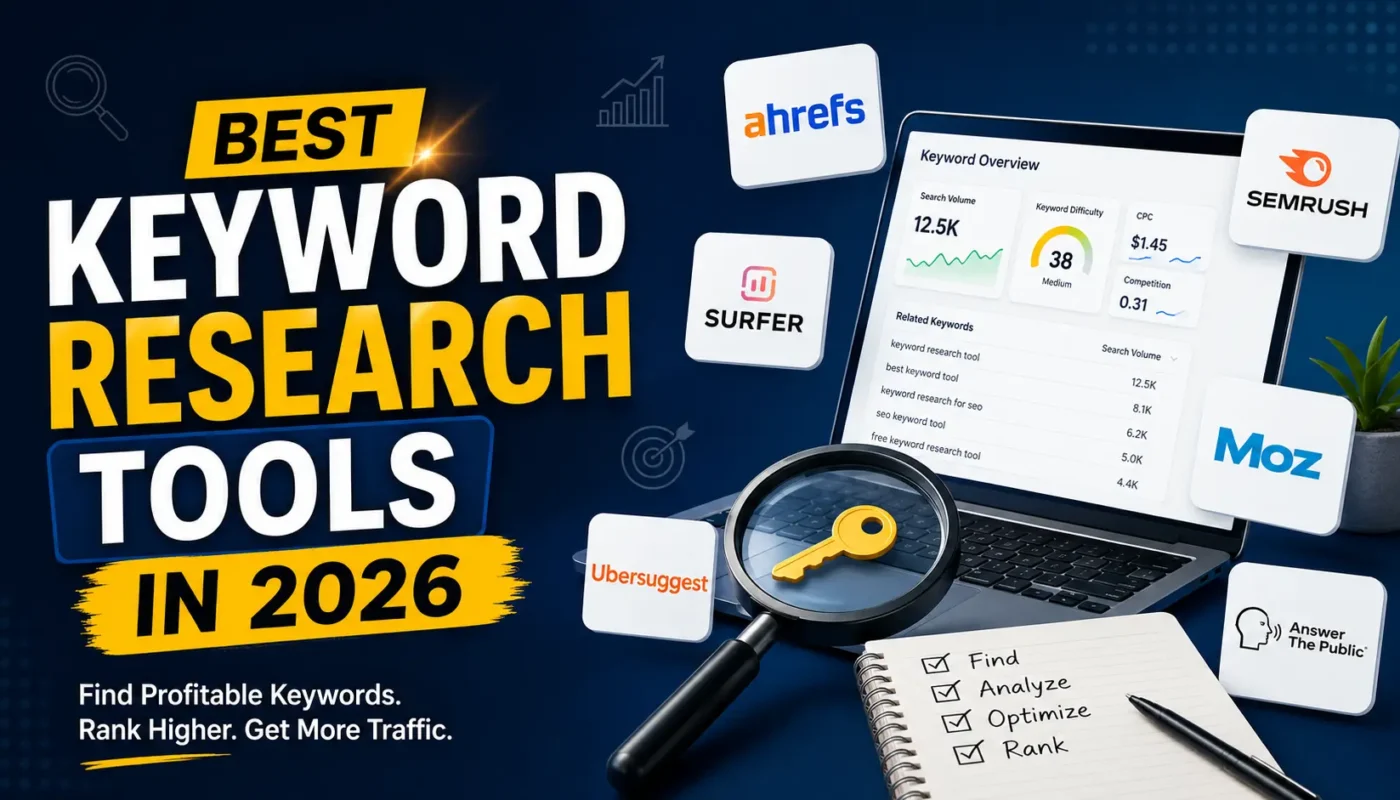
This guide focuses on the keyword research tools that actually help different types of websites make better SEO decisions—without turning keyword research into a full-time job.
What Makes a Keyword Research Tool Useful in 2026?
A few years ago, most people only cared about search volume.
That approach feels outdated now.
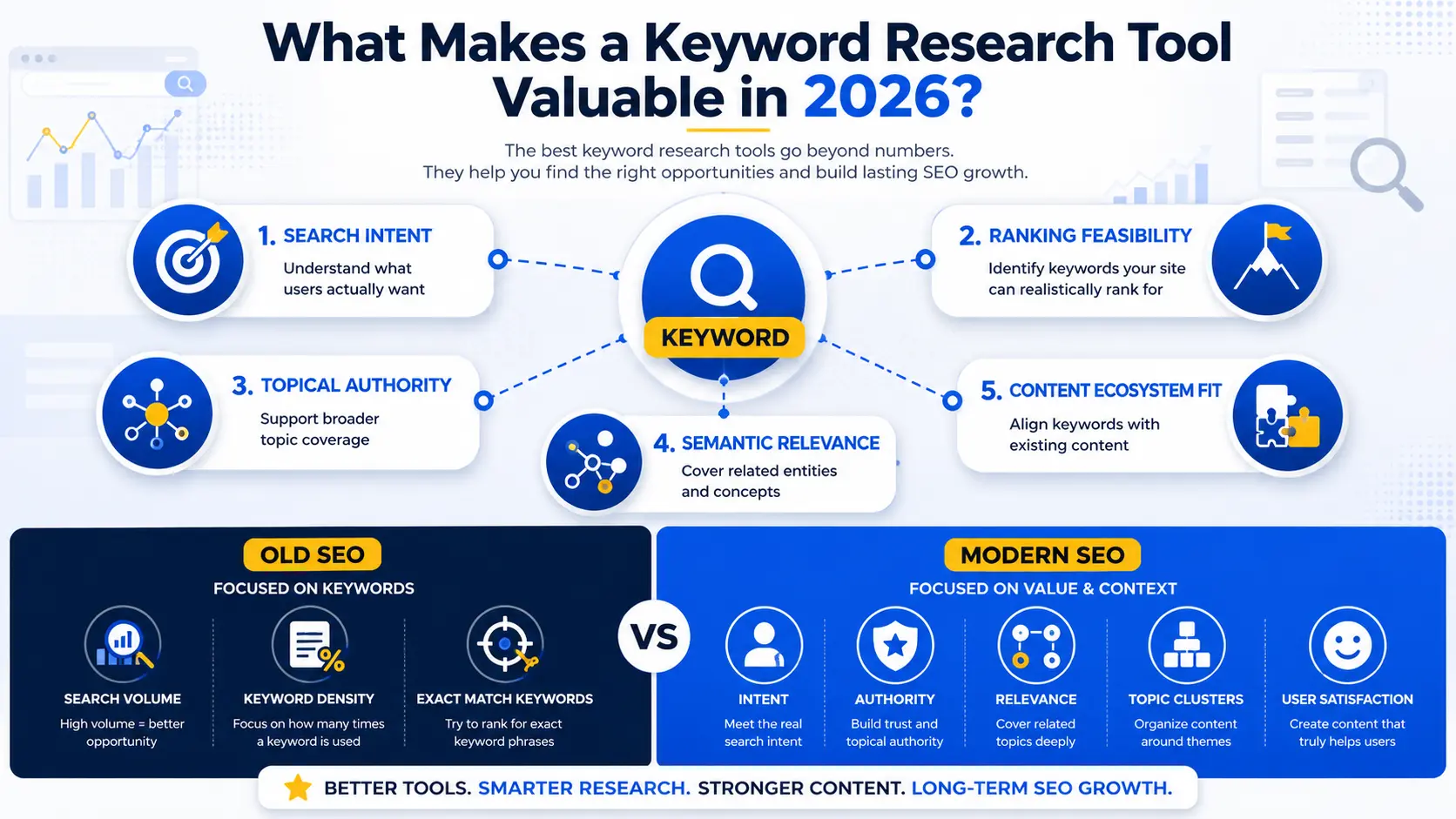
Modern SEO is more about:
- search intent,
- topical authority,
- ranking feasibility,
- semantic relevance,
- and content ecosystems.
A keyword with lower volume can easily outperform a high-volume keyword if:
- competition is weaker,
- the intent is clearer,
- and your website fits the topic naturally.
The best keyword research tools now help you understand:
- what users actually want,
- how difficult ranking will be,
- and whether the keyword fits your existing content strategy.
Not just raw numbers.
Ahrefs Still Sets the Standard for Serious SEO Work
Ahrefs is still one of the strongest SEO platforms for websites focused on long-term organic growth.
Its biggest strength isn’t only keyword data. It’s workflow efficiency.
You can:
- analyze competitors,
- discover content gaps,
- track rankings,
- and evaluate keyword opportunities
inside one system.
That becomes valuable once your content operation grows.
What Ahrefs does particularly well:
- competitor keyword analysis,
- low-competition keyword discovery,
- topical cluster research,
- content gap analysis.
Where it becomes less ideal:
- beginners,
- very small budgets,
- simple local SEO projects.
Honestly, many smaller websites buy Ahrefs too early and end up using only a fraction of its features.
Still, if you’re serious about scaling SEO content, it’s difficult to ignore.
Semrush Works Better for Broader Marketing Teams
Semrush is excellent for businesses managing SEO alongside paid advertising, social media, and broader digital marketing campaigns.
It’s less focused purely on keyword discovery and more focused on complete marketing visibility.
That’s useful for:
- agencies,
- SaaS companies,
- ecommerce brands,
- larger marketing teams.
Its keyword intent filters and competitive analysis tools are genuinely strong.
But there’s a trade-off.
Semrush can feel overwhelming quickly, especially for beginners. I’ve seen users spend more time exploring dashboards than actually publishing content.
For advanced marketers, though, the ecosystem is powerful.
LowFruits Is One of the Best Tools for Smaller Websites
LowFruits became popular because it solves a problem most SEO tools still handle poorly:
finding keywords with weak competition.
Instead of focusing heavily on keyword difficulty scores, LowFruits highlights SERPs filled with:
- weaker websites,
- forums,
- Reddit results,
- low-authority pages,
- and thin content.
That’s extremely useful for newer sites.
A lot of beginners waste time chasing keywords dominated by huge publishers. LowFruits helps avoid that mistake.
What makes it appealing:
- simpler interface,
- faster keyword filtering,
- beginner-friendly workflow,
- realistic ranking opportunities.
It’s not a complete SEO platform like Ahrefs or Semrush, but for keyword discovery specifically, it’s surprisingly effective.
Google Search Console Is Still Massively Underrated
Google Google Search Console isn’t technically a keyword research tool in the traditional sense.
But experienced SEO teams rely on it constantly.
Why?
Because it reveals:
- hidden impressions,
- near-ranking pages,
- CTR opportunities,
- and keywords Google already associates with your content.
Sometimes the easiest traffic gains come from improving pages already ranking on page two instead of targeting entirely new keywords.
That’s something many beginners overlook.
Search Console also becomes more valuable as your site grows because it reflects real search visibility instead of estimated third-party data.
And unlike most SEO tools, the data comes directly from Google.
Keywords Everywhere Keeps Research Simple
Keywords Everywhere is useful because it reduces friction.
Instead of constantly opening SEO dashboards, you see keyword data directly inside search results.
That sounds minor, but it speeds up research dramatically.
It works especially well for:
- bloggers,
- content writers,
- affiliate marketers,
- lightweight SEO workflows.
The tool won’t replace enterprise SEO suites, but not every project needs enterprise complexity.
Sometimes simplicity improves execution.
That’s part of the reason many experienced content creators still use lightweight tools even when they have access to expensive platforms.
Surfer SEO Helps More With Optimization Than Discovery
Surfer SEO is often grouped with keyword research tools, but I think its real strength is content optimization.
Once you already know your target keyword, Surfer helps improve:
- semantic coverage,
- entity relevance,
- topical completeness,
- and content structure.
That becomes useful when building topical authority.
Especially if you’re already improving content frameworks and internal SEO systems.
A deeper breakdown of that process is covered in:
“The SEO Content Writing Framework That Actually Ranks in 2026.”
One important caution though:
blindly following optimization scores can make content feel robotic.
That’s becoming increasingly risky as Google gets better at detecting templated SEO writing.
Free Keyword Research Tools Are Better Than Most People Think
Not every website needs expensive SEO software immediately.
A surprisingly effective free workflow can include:
- Google Trends,
- Search Console,
- Google Keyword Planner,
- AnswerThePublic.
Used together, these tools can uncover:
- trend opportunities,
- question-based searches,
- seasonal topics,
- and informational intent patterns.
The downside is workflow fragmentation.
Paid tools mainly save time by centralizing everything.
Still, for newer sites with limited budgets, free tools are more capable now than they were a few years ago.
What Most Keyword Research Guides Get Wrong
A lot of SEO content still treats keyword research like a numbers game.
But rankings in 2026 depend heavily on:
- topical relevance,
- internal linking,
- content ecosystems,
- and intent alignment.
You can’t just pick high-volume keywords and expect traffic anymore.
In fact, some lower-volume keywords drive better results because:
- competition is weaker,
- conversion intent is stronger,
- and topical fit is cleaner.
This becomes even more important if you’re already building topical clusters around related SEO subjects.
A deeper explanation is covered in:
“How to Build Topical Clusters That Rank (With Real Examples).”
Which Keyword Research Tool Should You Actually Choose?
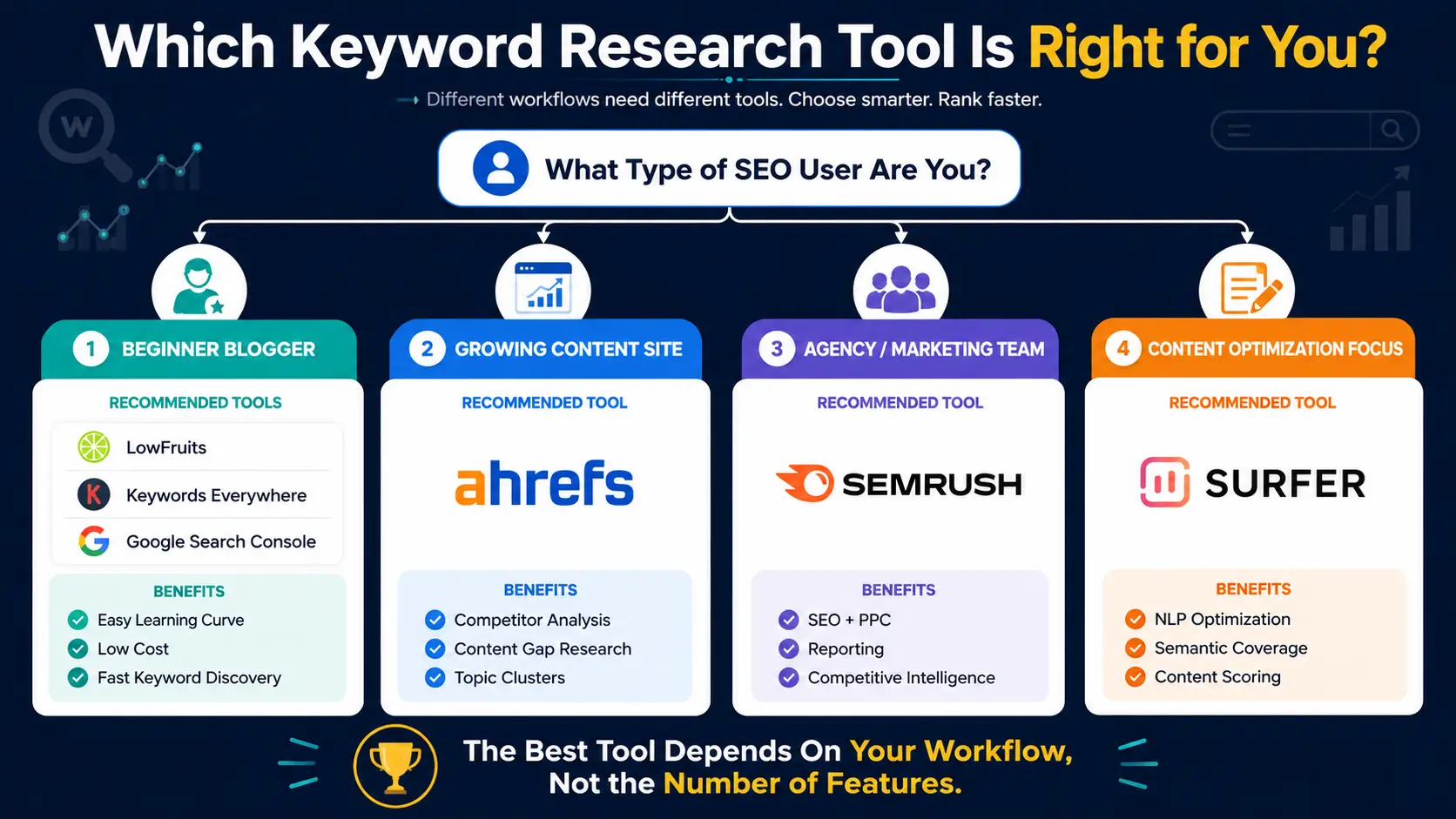
The answer depends entirely on your situation.
If You’re a Beginner
Start with:
- LowFruits
- Keywords Everywhere
- Google Search Console
These tools are easier to learn and help you focus on practical opportunities instead of overwhelming data.
If You’re Scaling Content Aggressively
Use:
- Ahrefs
It’s still one of the strongest platforms for:
- competitor analysis,
- content gap research,
- topical planning,
- and long-term SEO growth.
If You Run an Agency or Marketing Team
Choose:
- Semrush
The broader marketing ecosystem makes more sense for teams handling:
- SEO,
- PPC,
- reporting,
- and campaign visibility together.
If Your Focus Is Content Optimization
Use:
- Surfer SEO
Especially when improving semantic coverage and topical depth for existing articles.
Common Keyword Research Mistakes That Waste Time
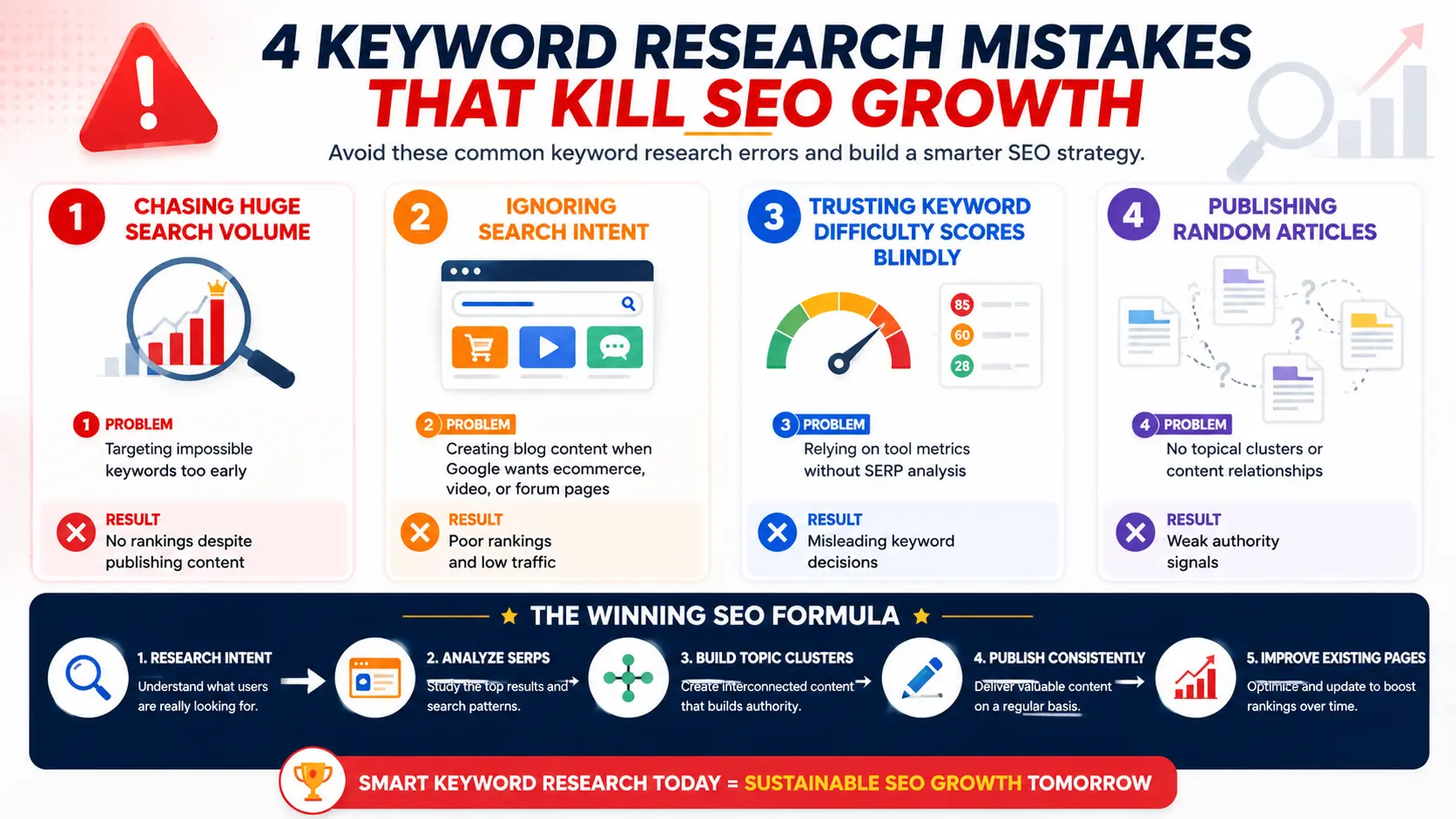
Chasing Huge Search Volume Too Early
Beginners often target massive keywords before their site has enough authority.
Smaller wins usually compound faster.
Ignoring Search Intent
A keyword may look attractive until you analyze the actual search results.
If Google mostly ranks:
- ecommerce pages,
- forums,
- or videos,
your article may struggle regardless of quality.
Trusting Difficulty Scores Too Much
Keyword difficulty tools are estimates, not absolute truth.
Manual SERP analysis still matters.
Sometimes “easy” keywords are harder than they look.
Publishing Random Topics Without Clusters
One isolated article rarely builds strong SEO momentum anymore.
Google increasingly rewards websites with clear topical relationships between content pieces.
This becomes even more important if you’re improving on-page SEO systems and internal linking strategies.
A deeper breakdown is covered in:
“The On-Page SEO Strategy That Still Works in 2026 (Most Sites Still Ignore This).”
Final Thoughts
The best keyword research tools in 2026 aren’t necessarily the ones with the most features.
They’re the ones that help you:
- find realistic opportunities,
- understand search intent,
- build topical relevance,
- and publish smarter content consistently.
For some websites, that’s Ahrefs.
For others, it’s a combination of free tools and sharper execution.
The important thing is understanding this:
Good keyword research doesn’t just help you find traffic.
It helps you avoid wasting months targeting keywords your site was never realistically going to rank for in the first place.