 by
by Introduction
A whole lot of websites are creating more content than ever… and getting less traffic from it.
Not because SEO is “dead.”
Not because AI murdered search.
The real problem is often simpler: their on page SEO strategy is stuck in 2021.
I’ve seen blog posts with solid backlinks but fail completely because the page itself is weak. Bad search intent. Poor structure. General headings. No depth on topic. Meanwhile, smaller sites with cleaner optimization quietly beat out giant publishers.
This guide is not just another recycled checklist.
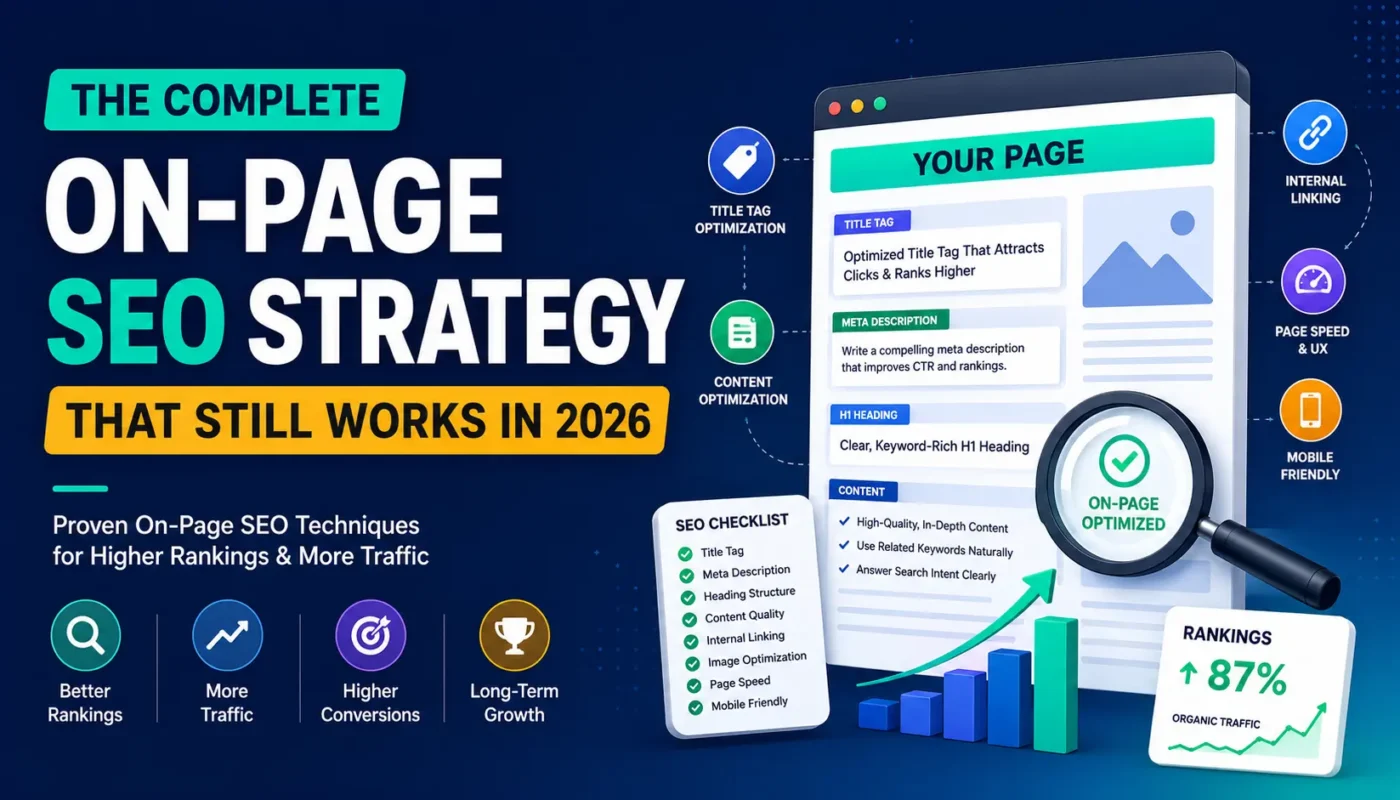
This is the actual on-page SEO framework that still powers rankings in 2026.
What Is an On-Page SEO Strategy?
An on page SEO strategy is the process of optimizing individual pages so Google can better understand, trust, and rank them.
But in 2026, this goes far beyond:
- adding keywords
- optimizing title tags
- stuffing headings
Modern on-page SEO is about alignment.
You are aligning:
- search intent
- content structure
- topical depth
- user experience
- internal linking
- engagement signals
The pages winning today feel genuinely useful.
That’s the difference.
Why On-Page SEO Matters More Than Ever
AI-generated content flooded the internet.
Google knows this.
That’s why search engines now rely heavily on:
- content quality
- topical authority
- UX signals
- semantic relevance
- engagement behavior
That is,
Google doesn’t rank pages anymore just for mentioning a keyword.
Orders pages that provide better answers to the search.
Quite frankly, this is good news for smaller sites.
Because smart optimization can now beat out raw authority in many SERPs.
Why Most Websites Still Fail at On-Page SEO
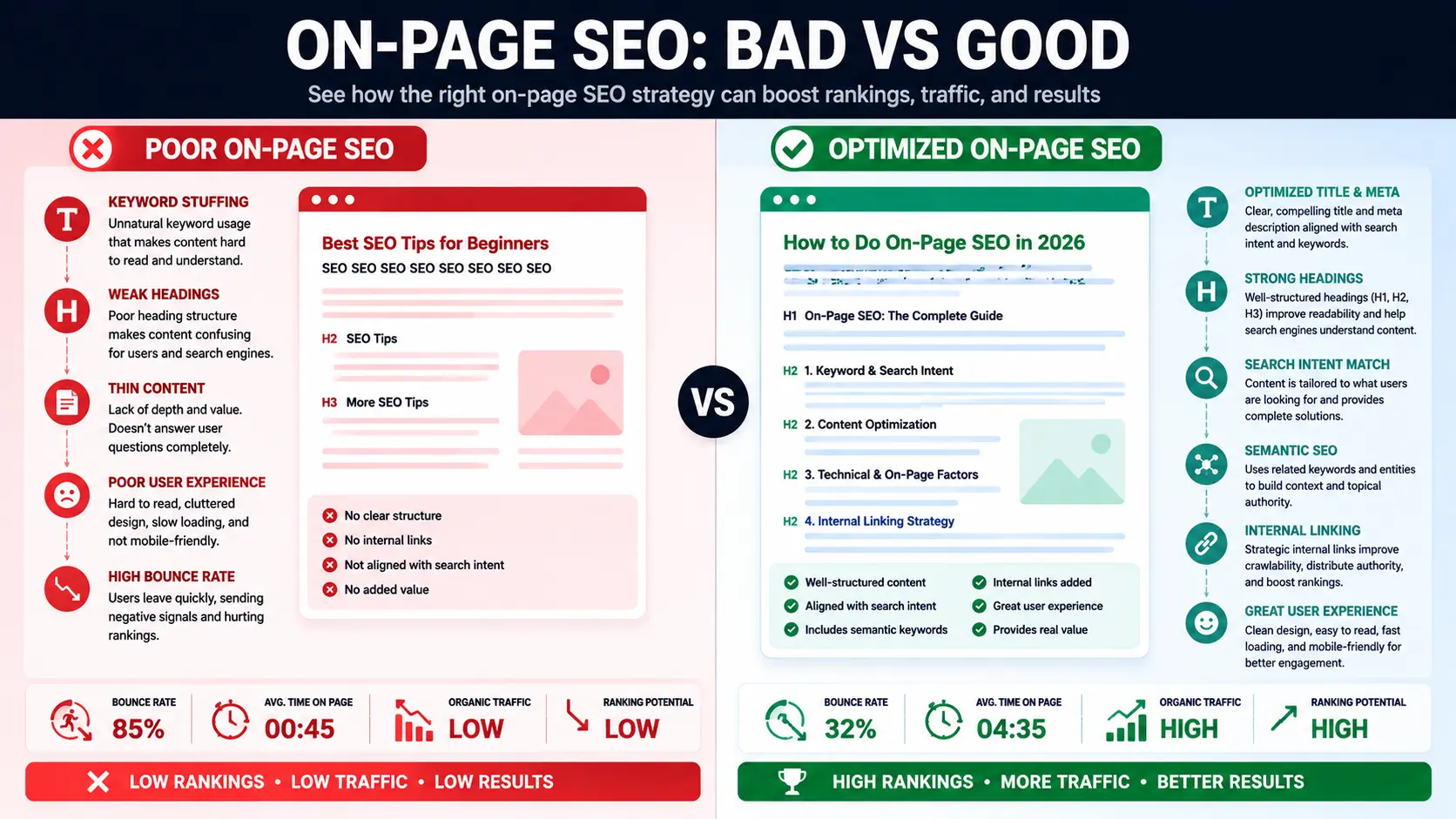
They Optimize for Robots Instead of Humans
You can spot this instantly.
The article sounds robotic:
- awkward keyword placement
- repetitive subheadings
- no personality
- no depth
Google’s systems are getting frighteningly good at detecting “manufactured usefulness.”
If users bounce fast, rankings usually follow.
They Ignore Search Intent
This is probably the biggest ranking killer I see.
Someone targets:
“best SEO tools”
But writes:
“What is SEO?”
That mismatch destroys rankings.
Before optimizing anything, ask:
“What does the searcher actually want here?”
Informational?
Commercial?
Comparison?
Transactional?
Intent alignment matters more now than raw keyword density.
Their Content Structure Is Weak
Huge walls of text.
No hierarchy.
Confusing headings.
Even good information becomes hard to consume.
Strong on-page SEO improves readability first.
Because readable content performs better behaviorally:
- more dwell time
- lower bounce rate
- higher interaction
Google notices all of it.
The Modern On-Page SEO Strategy That Actually Works
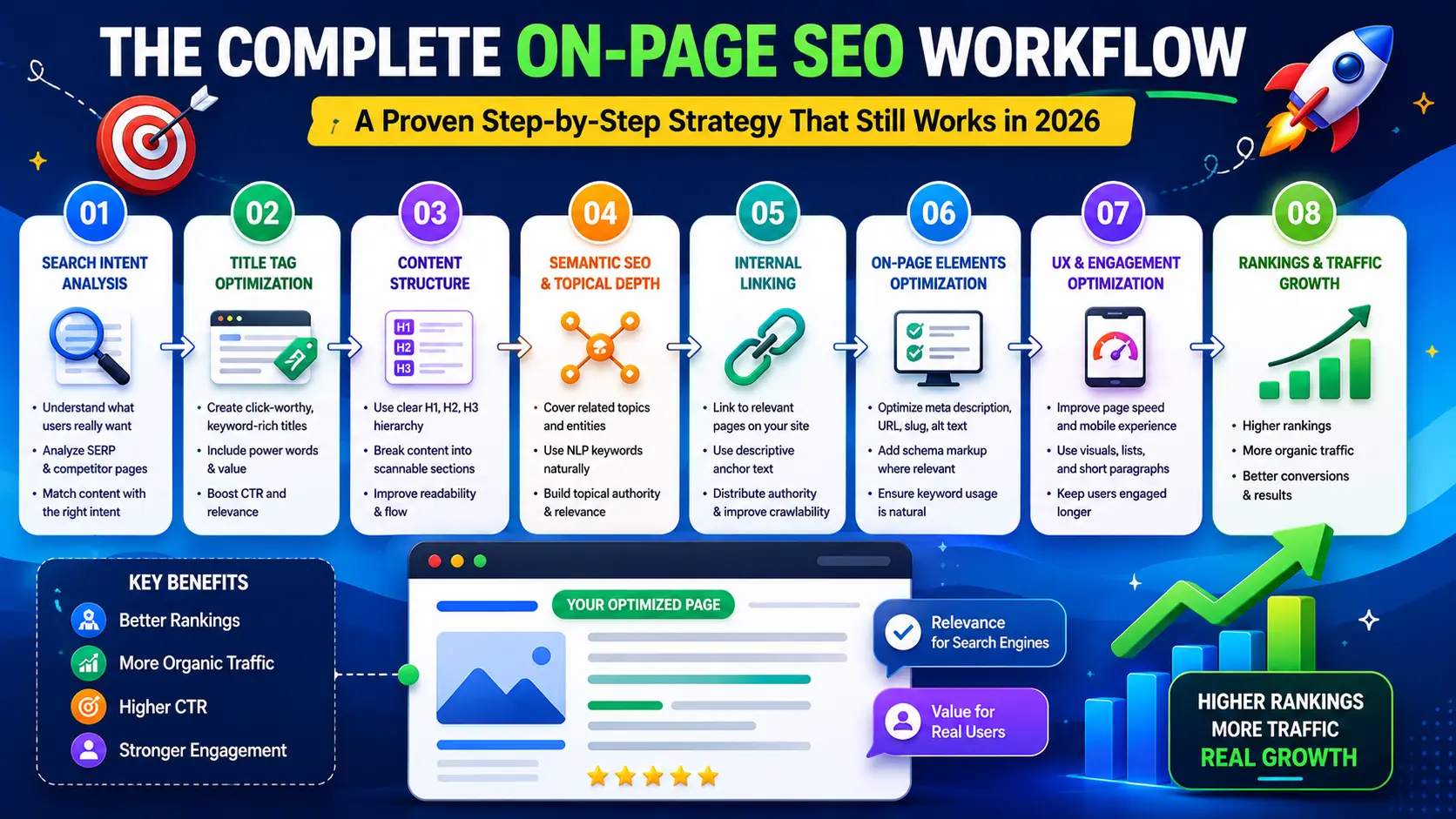
Start With Search Intent Mapping
Before writing a single word, study the SERP carefully.
Look at:
- article formats
- content depth
- common headings
- ranking patterns
- featured snippets
- Reddit or forum appearances
This tells you what Google expects.
One thing I’ve noticed lately:
If forums dominate a SERP, Google probably wants practical experience—not polished corporate writing.
That changes your approach completely.
Build Topical Relevance Before Publishing
One isolated article rarely ranks consistently anymore.
Google wants contextual authority.
That’s why topical clusters work so well.
If you want deeper guidance on this, check the guide on:
“How to Build Topical Clusters That Rank (With Real Examples).”
A single optimized article is helpful.
An interconnected content ecosystem is powerful.
Optimize Titles for Clicks, Not Just Keywords
Most title tags are painfully generic.
Example:
Bad:
“On Page SEO Guide”
Better:
“The On-Page SEO Strategy That Still Works in 2026”
The second one:
- creates curiosity
- promises relevance
- feels timely
- increases CTR
Higher CTR often improves ranking stability over time.
Write Introductions That Reduce Bounce Rate
The intro decides whether users stay or leave.
A good intro should:
- identify the pain point
- create emotional relevance
- promise clarity
- avoid fluff
One mistake I see constantly:
People waste 300 words defining SEO before helping the reader.
Users don’t care about definitions first.
They care about solving their problem.
Use Heading Structures That Guide Readers Naturally
Strong heading hierarchy improves:
- readability
- semantic clarity
- featured snippet potential
I usually recommend:
- one clear H1
- logical H2 sections
- scannable H3 breakdowns
But don’t force keywords unnaturally.
Google understands context much better now.
Improve Semantic Coverage Instead of Keyword Stuffing
Modern SEO optimization techniques rely heavily on semantic depth.
That means covering:
- related subtopics
- user questions
- contextual entities
- supporting concepts
Instead of repeating:
“on page seo strategy”
25 times.
Talk naturally about:
- title tag optimization
- internal linking SEO
- content depth
- search intent
- topical authority
- UX optimization
That creates richer relevance signals.
Internal Linking Is Still Wildly Underrated
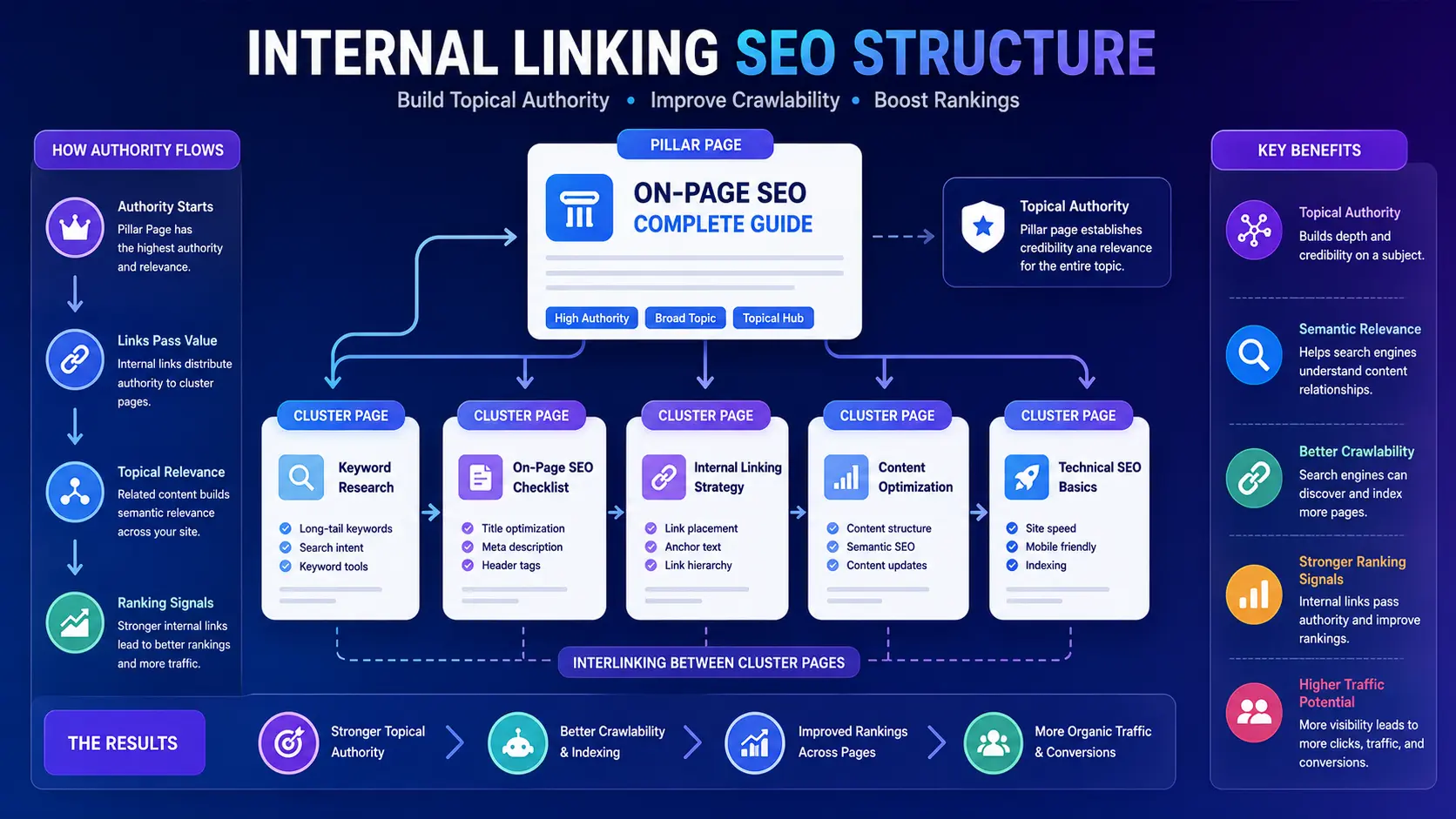
Internal linking SEO is honestly one of the easiest ranking wins available right now.
Most websites barely use it strategically.
Good internal links:
- distribute authority
- improve crawlability
- increase page depth
- reinforce topical relationships
For example, this article naturally connects with:
- SEO checklists
- content writing frameworks
- keyword research
- topical clusters
That interconnected structure strengthens the entire site.
If you want a practical implementation framework, check:
“The Only SEO Checklist for Blog Posts You Actually Need in 2026.”
Best On-Page SEO Tools Worth Using in 2026
Surfer SEO
Best For
Content optimization and SERP-driven writing.
Why It’s Useful
Surfer helps identify missing entities, content gaps, and optimization opportunities.
Hidden Insight
A lot of people over-optimize with Surfer.
Use its suggestions directionally—not religiously.
Frase
Best For
Search intent analysis and content briefs.
Why It Stands Out
Frase is excellent for understanding topical patterns quickly.
Limitation
Its AI suggestions still need heavy human editing to avoid generic output.
Ahrefs
Best For
SERP analysis and competitor research.
Why It Matters
You can reverse-engineer ranking structures before writing.
Pro Insight
I use Ahrefs more for content positioning than keyword volume these days.
Rank Math
Best For
Technical on-page optimization inside WordPress.
Why It Helps
Easy schema control, metadata optimization, and indexing improvements.
Limitation
Don’t blindly follow plugin scores. They oversimplify SEO.
Google Search Console
Best For
Finding hidden ranking opportunities.
Why It’s Powerful
The best SEO data often comes directly from Google itself.
Smart Use Case
Look for impressions with low CTR. Those are title optimization opportunities.
Free and massively underused.
Honest Comparison: Which SEO Tool Is Actually Worth It?
If you’re a beginner:
- Rank Math + Search Console is enough initially.
If you’re scaling content:
- Surfer + Ahrefs becomes extremely powerful.
If budget matters:
- Frase usually provides better value than enterprise-level optimization suites.
What most blogs won’t tell you:
Tools don’t create rankings.
Better positioning creates rankings.
The tool simply accelerates analysis.
How to Choose the Right On-Page SEO Strategy
If You’re a Beginner
Focus on:
- search intent
- clean structure
- strong headings
- internal links
Do not obsess over advanced metrics yet.
If You Run a Small Business Website
Prioritize:
- local relevance
- conversion clarity
- trust signals
- user experience
Traffic without conversions is vanity.
If You’re Scaling Content Aggressively
You need:
- topical clusters
- content workflows
- optimization systems
- strong internal architecture
At this stage, consistency matters more than perfection.
Common On-Page SEO Mistakes That Hurt Rankings
Over-Optimizing Content
This still happens constantly.
Too many:
- exact-match keywords
- awkward headings
- repetitive phrases
The content feels artificial.
Google increasingly rewards natural writing patterns.
Ignoring Content Freshness
Old statistics.
Outdated screenshots.
Irrelevant recommendations.
Freshness matters more in competitive niches now.
Updating existing content often beats publishing new content.
Weak Internal Linking
A lot of websites publish articles that exist in isolation.
No contextual relationships.
No authority flow.
That weakens topical signals dramatically.
Writing Without a Content Framework
Random content creation usually leads to random traffic.
If you want a better process, check:
“The SEO Content Writing Framework That Actually Ranks in 2026.”
It connects directly with this strategy.
Expert Insights Most SEO Blogs Never Mention
Google Measures Satisfaction More Than Optimization
This is the big shift.
A perfectly optimized page that users dislike will struggle long term.
Meanwhile, genuinely useful content with imperfect optimization often survives updates better.
That tells you everything.
UX Is Quietly Becoming an SEO Weapon
Tiny things matter:
- spacing
- readability
- mobile experience
- visual hierarchy
- page speed
Most people still separate UX and SEO.
That’s a mistake.
They are now deeply connected.
Topical Authority Compounds Over Time
One good page can rank.
But clusters dominate.
When Google repeatedly sees high-quality interconnected content around a topic, trust increases dramatically.
That’s why strategic internal linking and content ecosystems matter so much now.
Conclusion
The best on page SEO strategy in 2026 is not about gaming algorithms anymore.
It’s about creating genuinely useful pages that:
- satisfy intent
- feel readable
- connect topically
- solve problems better than competitors
That sounds simple.
But most websites still don’t do it well.
Focus less on “SEO tricks” and more on building pages users actually appreciate spending time on.
That’s what continues to win.