 by
by Introduction
A lot of sites don’t have a content issue. They have a problem with visibility.
A lot of pages that could generate traffic, leads, or affiliate revenue are buried under newer content, outdated information, weak internal linking, mismatched search intent, or keyword cannibalization.
This is why more publishing doesn’t always equal better rankings.
Eventually, growth stops being about creating new articles and starts being about improving the content you already have.
That’s where a proper SEO content audit is one of the highest-leverage activities in search engine optimization.
Instead of asking, “What should we publish next?” a content audit asks a more valuable question:
“What ranking opportunities are we already sitting on?”
What Is an SEO Content Audit?
An SEO content audit is the process of evaluating existing content to identify the following:
- Pages that deserve updates
- Content that should be consolidated
- Articles targeting the wrong search intent
- Keyword cannibalization issues
- Internal linking opportunities
- Technical obstacles affecting performance
- Content gaps within topical clusters
The objective is not simply to clean up old content.
The objective is to increase the performance of assets that already exist.
Why SEO Content Audits Matter More Than Most People Think
Many site owners assume growth comes from publishing more articles.
In practice, some of the largest ranking gains come from improving content that Google already understands.
Content audits can help
- Increase rankings without publishing new content
- Recover declining traffic
- Strengthen topical authority
- Improve crawl efficiency
- Enhance user experience
- Uncover hidden keyword opportunities
This becomes even more important if you’re already building topical authority across a specific niche.
Signs Your Website Needs a Content Audit
Traffic has plateaued.
Impressions are increasing but clicks remain low.
Multiple articles target similar topics.
Older content contains outdated information.
Important pages receive few internal links.
Pages rank on page two or three for valuable keywords.
These are all signals that optimization opportunities already exist inside your website.
The SEO Content Audit Framework
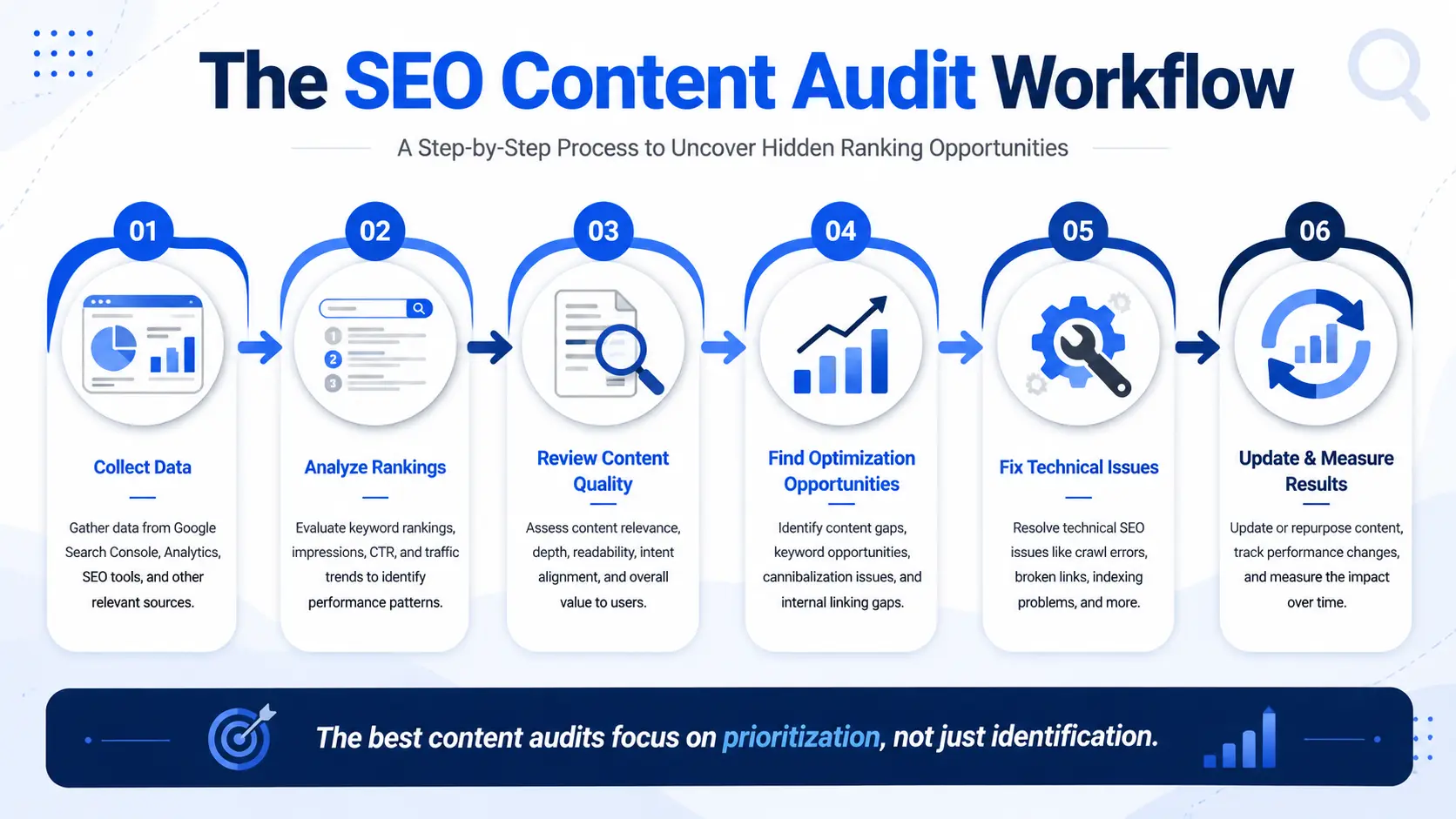
Step 1: Create a Complete Content Inventory
Start with a spreadsheet.
Document:
- URL
- Page title
- Target keyword
- Organic traffic
- Clicks
- Impressions
- Backlinks
- Internal links
- Last updated date
Most websites underestimate how difficult it becomes to optimize content when there is no central inventory.
Without visibility, prioritization becomes guesswork.
Step 2: Find Your Hidden Winners
Not all underperforming pages are weak pages.
Some pages are simply under-optimized.
Look for:
- Keywords ranking positions 8–20
- High impressions but low CTR
- Growing impression trends
- Pages attracting relevant traffic
These often represent the fastest SEO wins.
A page ranking #11 can sometimes reach page one with relatively small improvements.
Step 3: Identify Keyword Cannibalization
One of the most common ranking problems appears when multiple pages compete for the same topic.
Examples:
- Best SEO Tools
- SEO Tools for Beginners
- SEO Tools for Small Businesses
If the keyword targeting overlaps excessively, Google may struggle to determine which page should rank.
The solution isn’t always deletion.
Sometimes differentiation solves the problem.
Sometimes consolidation is necessary.
Step 4: Review Search Intent Alignment
Many pages fail because they satisfy the wrong intent.
A keyword may appear informational.
The actual search results may reveal commercial intent.
Before updating content, compare your page with current search results.
Ask:
- What content format dominates?
- Are users looking for guides?
- Reviews?
- Comparisons?
- Tutorials?
Intent mismatches often suppress rankings even when content quality is strong.
Step 5: Audit Internal Linking
Internal links are one of the most overlooked ranking signals available to site owners.
Look for:
- Orphan pages
- Weakly connected content
- Missing contextual links
- Broken internal paths
A deeper breakdown of this strategy is covered in your Internal Linking Strategy guide.
Strong internal linking helps search engines understand relationships between pages while distributing authority across topical clusters.
Step 6: Evaluate On-Page SEO Elements
Review:
- Title tags
- Meta descriptions
- H1 tags
- Header hierarchy
- Image optimization
- Schema markup
- Content freshness
Most websites focus on content quantity while ignoring basic optimization elements.
Small improvements here often compound over time.
Step 7: Analyze Topical Coverage
This stage separates advanced audits from basic audits.
Instead of analyzing individual pages, evaluate topic coverage.
Ask:
- Which subtopics are missing?
- Which questions remain unanswered?
- Which supporting articles are absent?
For example:
A topical authority cluster around keyword research may include:
- Keyword research tools
- Search intent
- Keyword clustering
- Competitor analysis
- Content planning
Missing supporting topics can limit the ranking potential of the entire cluster.
Step 8: Decide What Happens Next
Every page should receive one of four decisions:
Keep
The page performs well.
Update
The page has ranking potential but requires improvements.
Merge
Multiple pages overlap excessively.
Remove or Redirect
The content provides little value and serves no strategic purpose.
What Most Websites Get Wrong
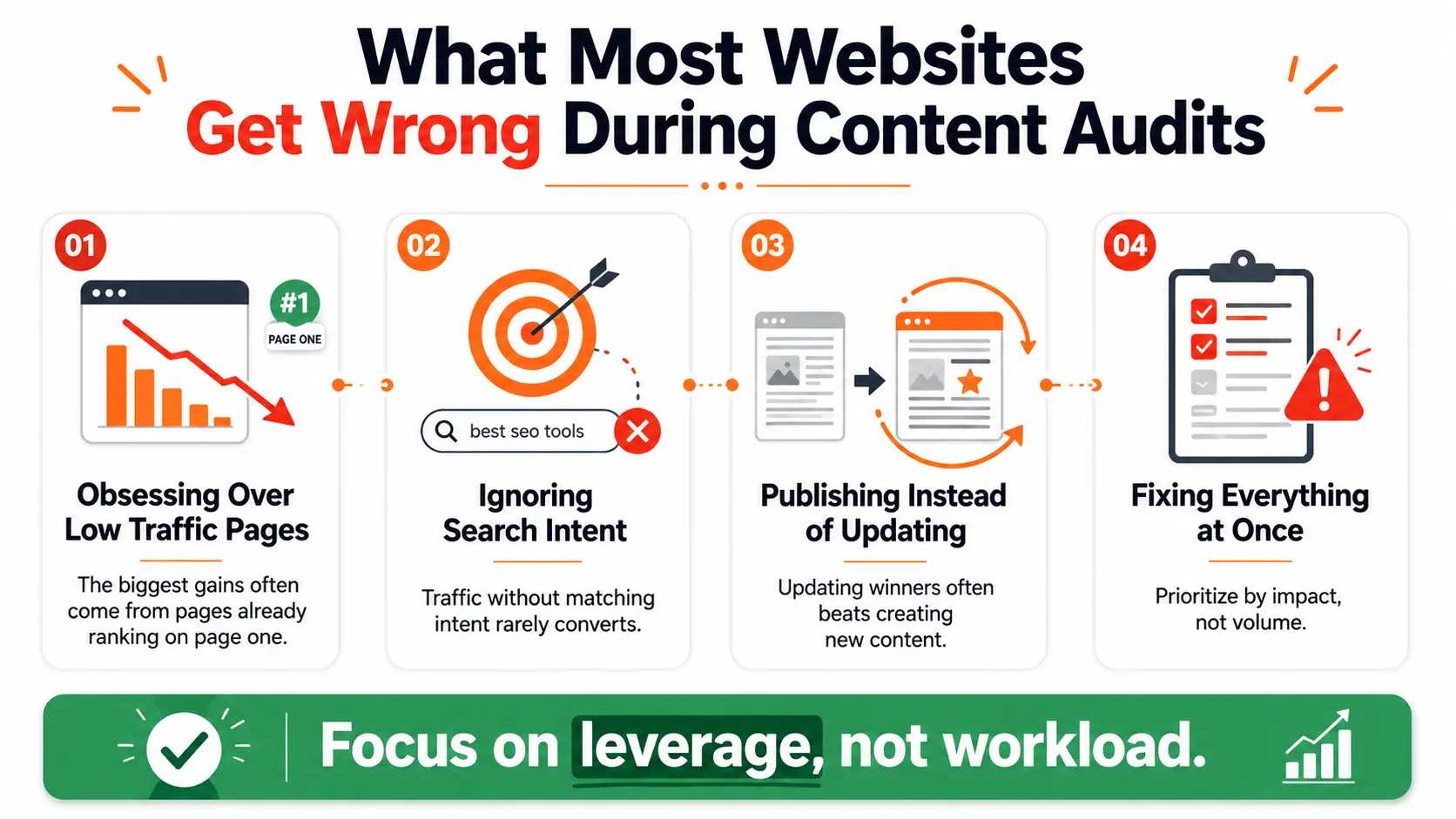
Most audits focus on pages.
The strongest audits focus on systems.
Google increasingly evaluates expertise through content ecosystems rather than isolated articles.
Many site owners obsess over:
- Word count
- Publishing frequency
- Keyword density
While ignoring:
- Content relationships
- Topic coverage
- Internal linking architecture
- Search intent consistency
A website with 40 strategically connected articles often outperforms a website with 100 disconnected articles.
Another mistake is treating every page equally.
Not every article deserves updates.
Prioritize pages closest to meaningful ranking gains.
The goal isn’t to improve everything.
The goal is to improve the right things first.
Recommended SEO Content Audit Tools
Google Search Console
Best for:
- Performance data
- CTR analysis
- Query insights
Google Analytics
Best for:
- Engagement analysis
- Conversion tracking
Screaming Frog
Best for:
- Site crawling
- Internal linking audits
- Technical content analysis
Semrush
Best for:
- Content audits
- Position tracking
- Competitive research
Ahrefs
Best for:
- Link analysis
- Content opportunities
- Keyword visibility
A Practical Audit Workflow for Small Websites
Monthly
- Review Search Console
- Identify declining pages
- Find CTR opportunities
Quarterly
- Run full content inventory review
- Audit internal links
- Evaluate topical coverage
Every Six Months
- Refresh high-value content
- Merge overlapping pages
- Update outdated statistics and examples
This process remains manageable while continuously improving rankings.
Conclusion
On most websites, the biggest ranking opportunities are rarely in future ideas for content.
They are buried in content that’s already there.
A good SEO content audit helps you identify pages that need more attention, identify weaknesses that prevent you from ranking well and build stronger links between the content on your site.
It will always be important to publish new articles.
But over the long-term, SEO growth often comes down to optimizing what you’ve already built.
The sites that are still getting organic traffic are not necessarily the ones producing the most content.
They are the ones that constantly assess, refine and strengthen their existing content ecosystem.