 by
by Most SEO content dies long before Google even gets to crawl it.
Not because the keyword was incorrect.
Not because the writer was untalented.
“It doesn’t work because there is no real framework behind it.
I’ve audited blog posts that appeared to be “SEO optimized” on the surface — proper headings, decent keywords, even internal links — yet still couldn’t break into page one. Meanwhile, less authoritative sites were quietly outranking them with simpler content.
“Generally, the difference is structure, intent alignment, and topical depth.
This is the SEO content writing framework I have seen work over and over again on blogs, niche sites, SaaS companies, and even low-authority websites trying to compete in brutal SERPs.
And honestly? Most competitors are still teaching outdated SEO writing tactics from 2021.”
Why SEO Content Writing Changed Completely
A few years ago, SEO content was mostly about:
- Adding keywords
- Writing longer articles
- Building backlinks
- Stuffing related terms
That approach still works a little.
But Google’s ranking systems are now evaluating:
- Search intent satisfaction
- Topical authority
- Information gain
- Content usefulness
- User engagement signals
- Experience-based insights
AI-generated content exploded the amount of mediocre content online. Google adapted by rewarding content that demonstrates actual understanding and contextual depth.
That’s why a real SEO content writing framework matters now more than ever.
What Is an SEO Content Writing Framework?
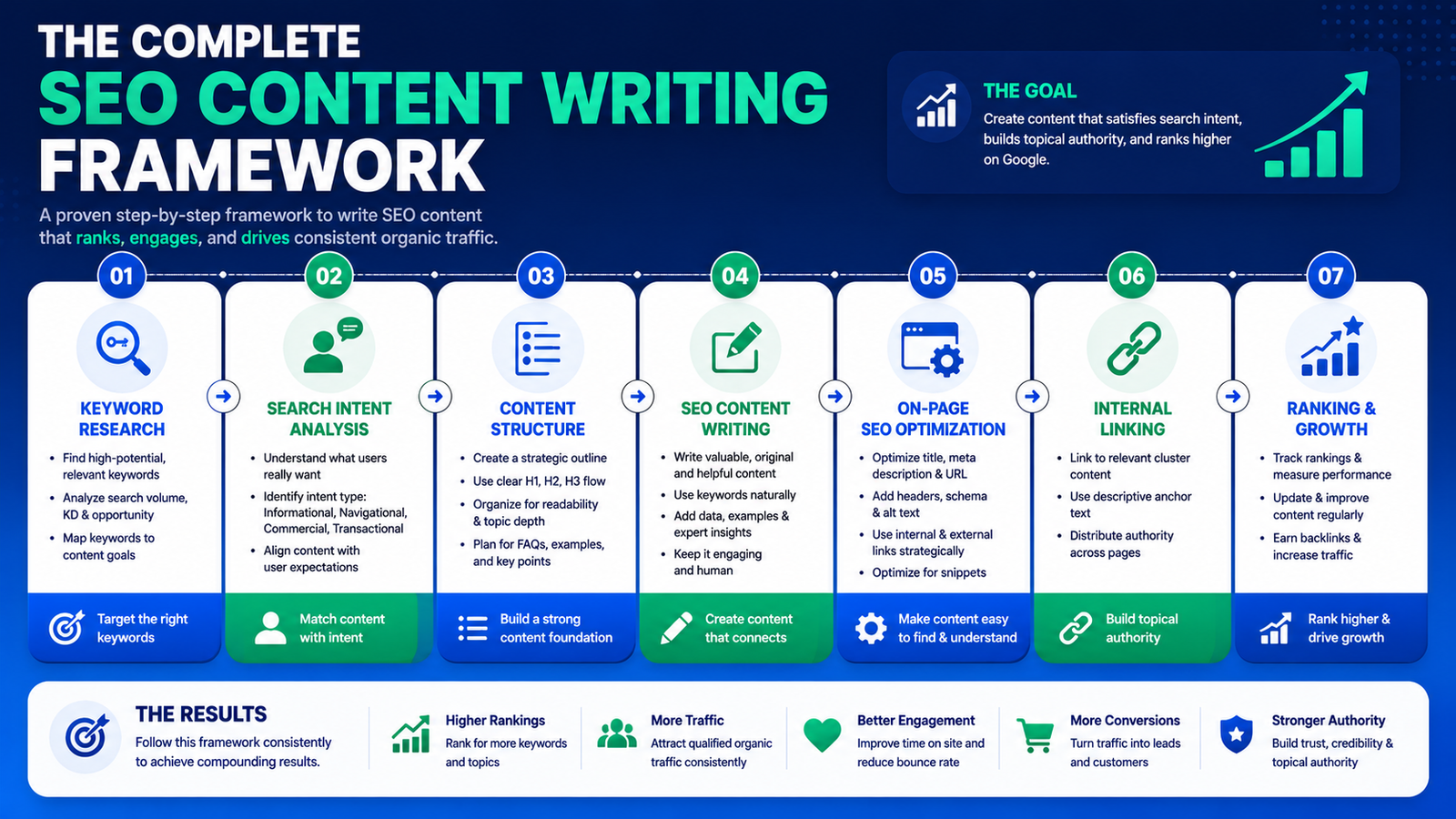
An SEO content writing framework is a structured process for creating content that:
- Matches search intent
- Solves a specific user problem
- Builds topical relevance
- Keeps readers engaged
- Helps search engines understand context
Good SEO writing isn’t about gaming algorithms anymore.
It’s about creating the most useful version of a page for a specific search query.
That sounds obvious. Yet most content still misses this entirely.
Why Most SEO Content Still Doesn’t Rank
This is the uncomfortable truth most blogs ignore:
Most content today is just rewritten content.
People open the top 5 ranking pages, combine the same talking points, add AI fluff, then publish another “me-too” article.
Google has already indexed thousands of those.
Here’s what usually kills rankings:
Weak Search Intent Matching
Someone searches “best SEO tools” and lands on a giant tutorial instead of a comparison.
Wrong format. Wrong intent.
Google notices users bouncing back.
Game over.
Surface-Level Content
A 4,000-word article can still feel empty.
Length doesn’t equal depth.
Depth comes from:
- Real examples
- Contrarian insights
- Strategic clarity
- Specific recommendations
- Experience-driven explanations
No Topical Connection
One isolated article rarely builds authority anymore.
This is why topical clusters matter so much now.
If you haven’t read it yet, check out the guide on How to Build Topical Clusters That Rank (With Real Examples) because this framework works exponentially better when connected through strategic internal linking.
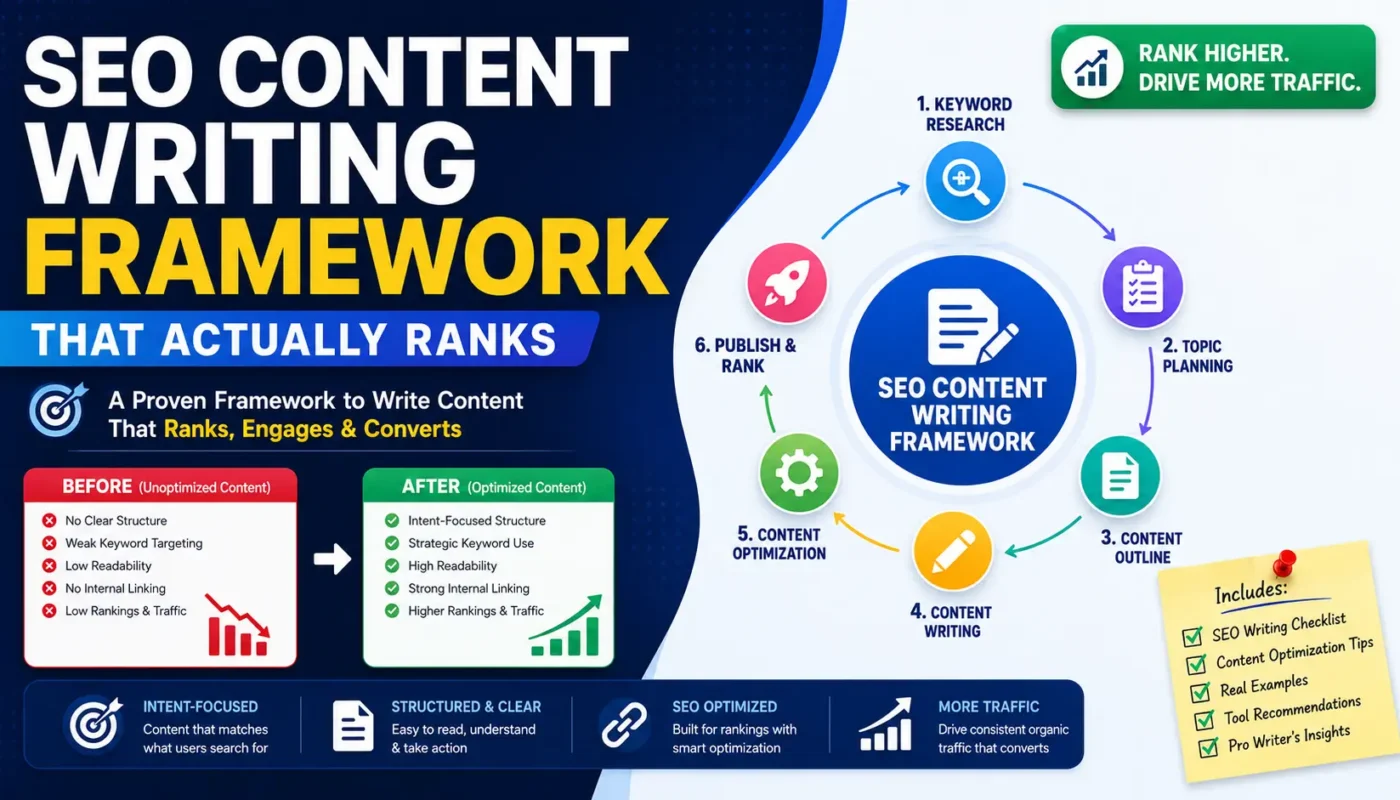
The SEO Content Writing Framework That Actually Works
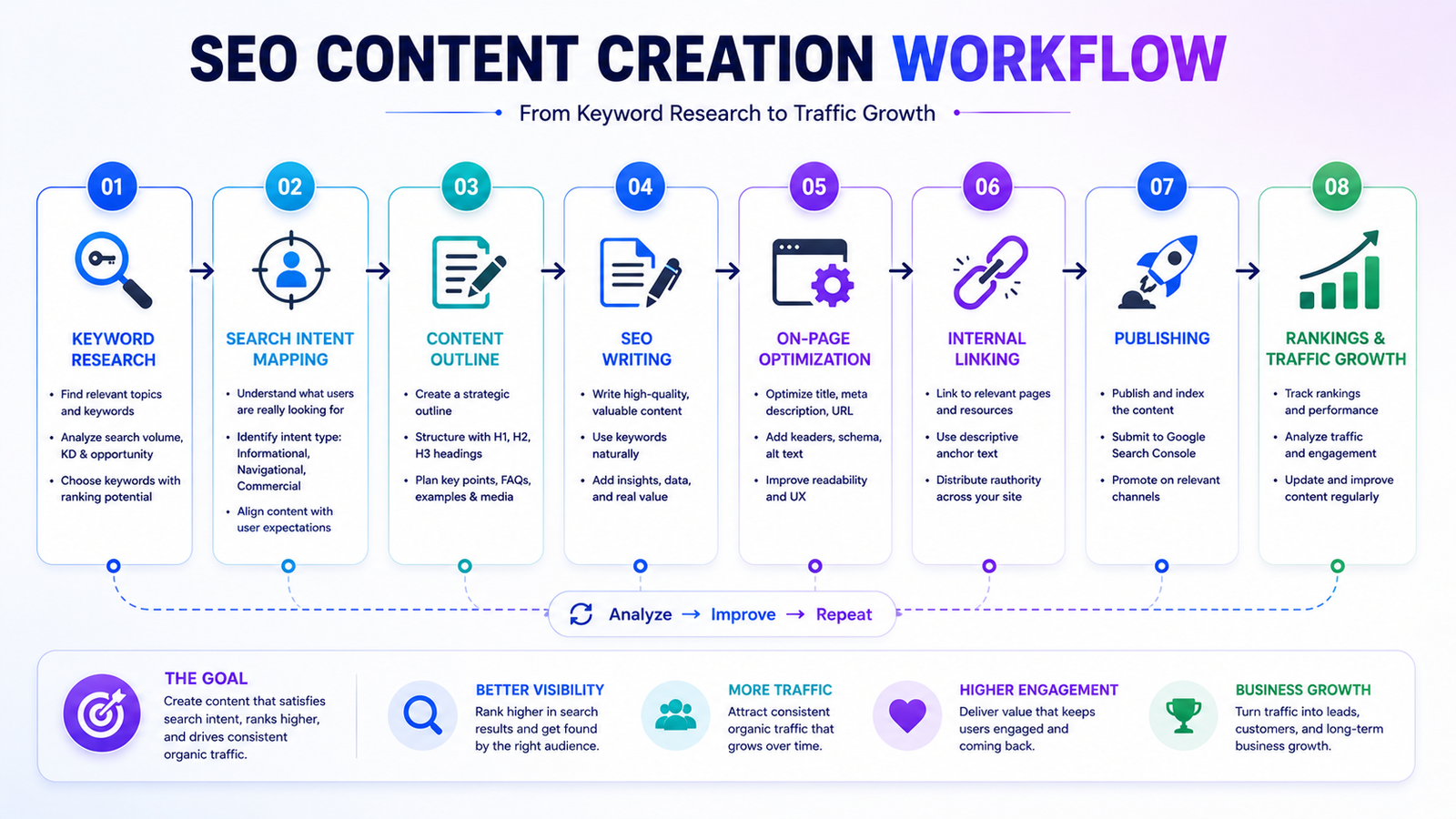
This is the exact structure I’d use today if I were building a new SEO site from scratch.
Step 1: Start With Search Intent — Not Keywords
This is where most people get it backward.
Keywords are just clues.
Intent is the real target.
Before writing anything, ask:
- Does the user want information?
- Comparisons?
- A tool recommendation?
- A tutorial?
- A quick answer?
- Validation before buying?
The easiest way to figure this out:
Google the keyword manually.
Study:
- Page formats
- Heading patterns
- SERP features
- Content angles
- Common pain points
If every top-ranking result is a comparison post and you publish a beginner guide, you’re fighting Google instead of aligning with it.
Step 2: Build Content Around Topic Depth
One article should solve the entire problem — not just parts of it.
This doesn’t mean stuffing everything into a monster guide.
It means covering the important angles naturally.
A good SEO article usually includes:
- Core explanation
- Practical implementation
- Examples
- Mistakes
- Comparisons
- FAQs
- Decision-making help
- Strategic insights
This is where many AI-generated articles fall apart.
They explain what something is but rarely explain why it matters in real scenarios.
Step 3: Create a Strong SEO Blog Writing Structure
Structure affects rankings more than people realize.
Good structure improves:
- Readability
- Engagement
- Crawlability
- Snippet opportunities
- Internal linking flow
A simple high-performing structure often looks like this:
Introduction
Hook the reader emotionally.
Problem Explanation
Show you understand the frustration.
Strategic Solution
Introduce the framework.
Actionable Steps
Break down implementation clearly.
Comparisons / Examples
Help readers make decisions.
Mistakes to Avoid
Increase practical value.
Expert Insights
Differentiate from competitors.
FAQs
Capture long-tail traffic.
Step 4: Use Semantic SEO Naturally
Google understands context far better now.
You no longer need awkward keyword stuffing.
Instead, cover related concepts naturally.
For example, if your topic is:
“seo content writing framework”
You should naturally discuss:
- search intent
- content optimization
- topical authority
- internal linking
- content clusters
- SERP analysis
- content structure
That creates contextual relevance without looking manipulated.
Step 5: Optimize for Information Gain
This is one of the most overlooked ranking concepts right now.
Google wants pages that add something new.
Not recycled summaries.
Information gain can come from:
- Original frameworks
- Real observations
- Contrarian insights
- Case-study style examples
- Unique workflows
- Tactical shortcuts
For example:
Most SEO blogs say:
“Use internal links.”
But they don’t explain:
- how many internal links matter
- where placement impacts engagement
- how anchor text affects topical signals
- why cluster architecture changes rankings
That’s the gap.
And ranking opportunities usually live inside those gaps.
Best SEO Content Optimization Tools (That Actually Help)
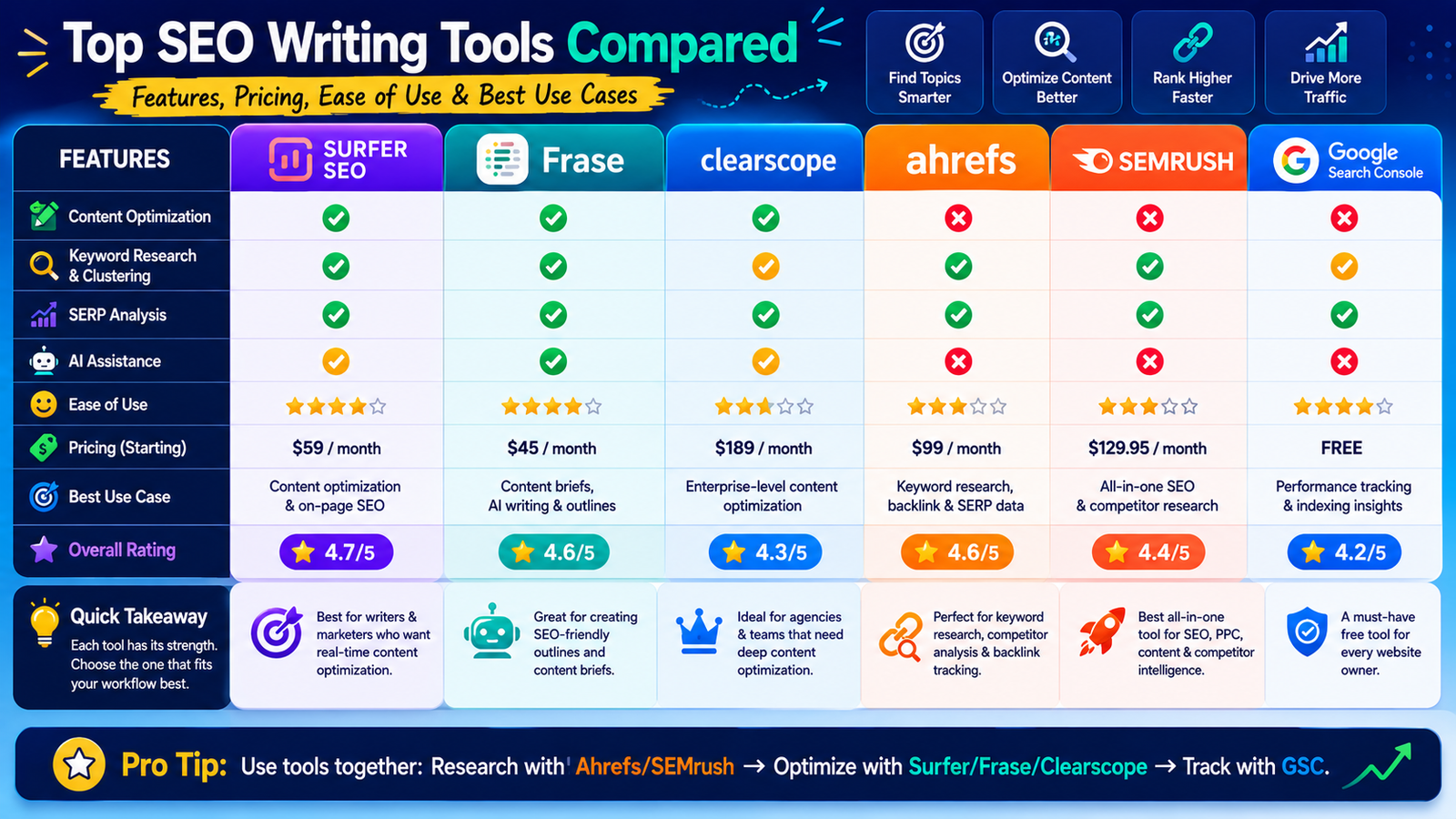
Some tools genuinely improve workflow.
Others just create noise.
Here are the ones I think actually help content quality.
Surfer SEO
What It Does
Analyzes top-ranking pages and suggests optimization opportunities.
Best For
Content teams scaling SEO production.
Where It Helps
- NLP keyword suggestions
- Structure optimization
- Content scoring
- SERP analysis
Limitation
Some people over-optimize trying to “hit the score.”
That creates robotic content.
Use the recommendations as guidance — not rules.
Frase
What It Does
Helps build SEO briefs and answer-focused content.
Best For
Writers creating informational content quickly.
Why I Like It
Frase is surprisingly good at identifying topical gaps competitors missed.
Limitation
Still requires strong editing and human judgment.
Ahrefs
What It Does
Keyword research, SERP analysis, and competitor intelligence.
Best For
Strategic content planning.
Hidden Advantage
The “Top Pages” report is underrated for finding low-competition opportunities.
This connects perfectly with the strategy in The “Low-Hanging Fruit” Fallacy: How to Actually Find Low Competition Keywords in 2026.
Google Search Console
What It Does
Shows real ranking and click data from Google.
Best For
Content optimization.
Pro Insight
Page 2 keywords are often the easiest traffic wins.
Tiny updates can create massive ranking jumps.
Grammarly
What It Does
Improves clarity and readability.
Best For
Reducing friction during reading.
Important Note
Don’t over-clean your writing.
Perfect grammar sometimes removes personality.
ChatGPT
What It Does
Helps with ideation, outlines, and content workflows.
Best For
Acceleration — not replacement.
Biggest Mistake People Make
Publishing AI drafts without adding experience, insight, or editing.
That’s exactly the type of content Google is getting better at filtering.
Honest Comparison: Which Tools Actually Matter?
Here’s the truth most affiliate blogs avoid saying:
You do NOT need every SEO tool.
If you’re a beginner:
- Google Search Console
- Ahrefs Webmaster Tools
- ChatGPT
- Grammarly
…are enough to start.
If you’re scaling content aggressively:
- Surfer SEO
- Frase
- Ahrefs
become valuable because they save time.
The real advantage isn’t the tools themselves.
It’s the decisions you make using the data.
How to Choose the Right SEO Writing Workflow
If You’re a Beginner
Focus on:
- Search intent
- Clarity
- Structure
- Internal linking
Don’t obsess over advanced optimization scores yet.
If You’re Building a Niche Site
Prioritize:
- Topic clusters
- Low-competition keywords
- Content consistency
- Information gain
This works especially well alongside the framework from The Only SEO Checklist for Blog Posts You Actually Need in 2026 (Rank Faster, Smarter).
If You’re Scaling a SaaS Blog
You need:
- Structured briefs
- Workflow efficiency
- Topical authority mapping
- Content refresh systems
This is where premium tools become worth the investment.
Common SEO Content Writing Mistakes
Writing Before SERP Analysis
Never write blindly.
Google already tells you what format users prefer.
Ignoring that creates mismatched content.
Keyword Stuffing
Still happening in 2026 somehow.
If your article sounds unnatural, rankings suffer eventually.
Weak Internal Linking
Internal links distribute authority and context.
Random linking doesn’t work nearly as well as strategic cluster linking.
Publishing Without Updating
SEO content decays faster now.
Especially in competitive industries.
Freshness matters more than most people realize.
Expert Insights Most SEO Blogs Never Mention
Here’s something I’ve seen repeatedly:
Google often rewards clarity over complexity.
Some of the highest-performing pages I’ve worked on were NOT the longest.
They were simply:
- easier to consume
- more useful
- better structured
- more aligned with intent
Another important observation:
Topical authority compounds.
Once Google trusts your site within a topic, ranking new content becomes dramatically easier.
That’s why building connected clusters matters more than isolated “viral” articles.
And honestly, this is probably where small websites still have an advantage over giant publishers.
Big brands move slowly.
Niche creators can move faster and create sharper, experience-driven content.
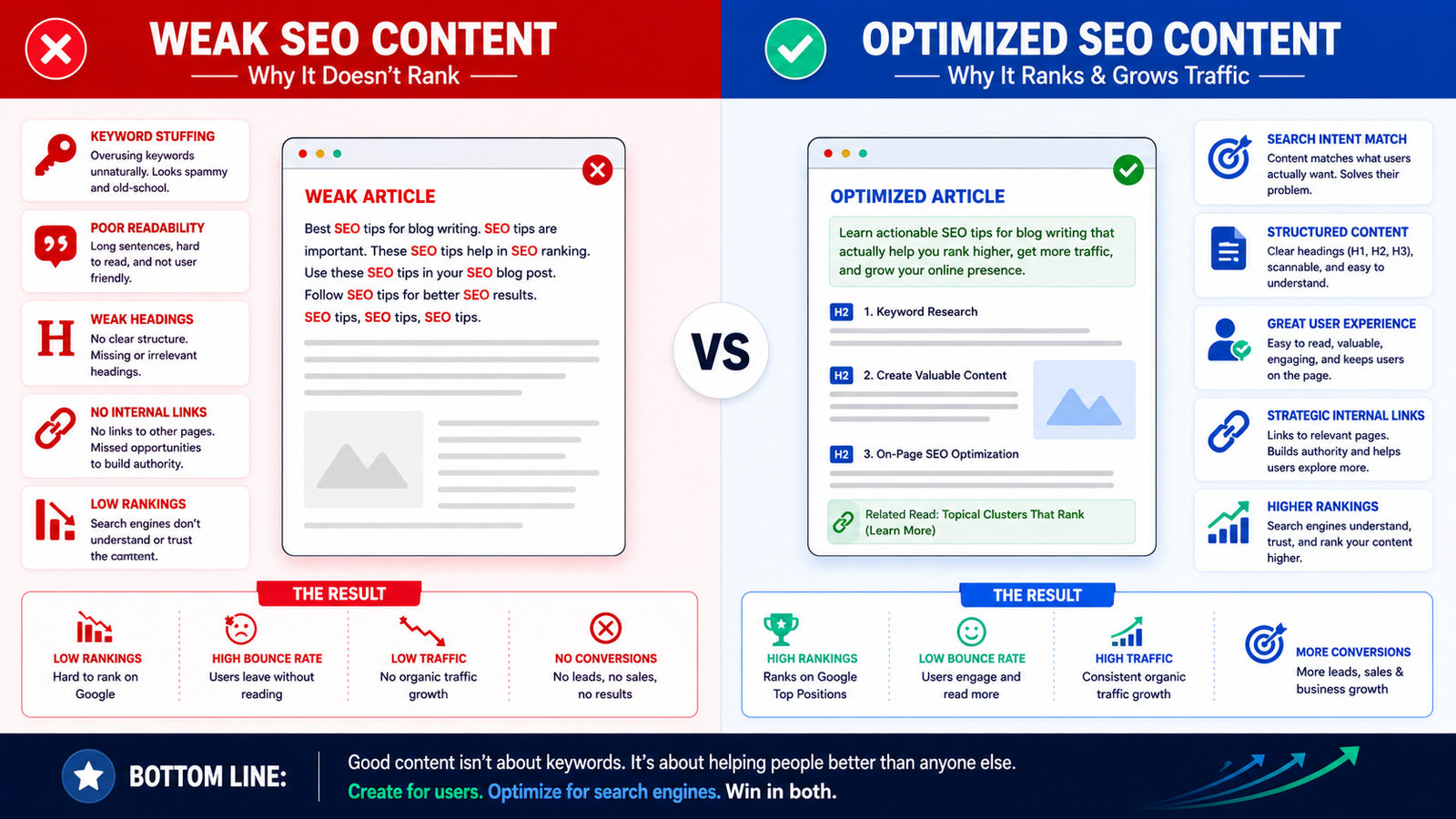
Before vs After: What Real SEO Optimization Looks Like
Before Optimization
- Generic introduction
- Weak headings
- Surface-level explanations
- No internal links
- Poor intent matching
- No topical depth
Result:
Page stuck on page 3.
After Optimization
- Strong SERP-aligned structure
- Better intent targeting
- Strategic internal links
- Content cluster integration
- Information gain added
- Improved readability
Result:
Higher engagement, stronger rankings, more organic traffic.
This is usually where the biggest ranking jumps happen.
Not from “hacks.”
From better alignment.
Conclusion
SEO content writing in 2026 is no longer about gaming search engines.
It’s about building the clearest, most useful, most contextually complete answer for a specific user problem.
That’s the framework.
If your content feels interchangeable with 500 other AI-generated articles, rankings will always be unstable.
But when you combine:
- search intent alignment
- topical authority
- smart structure
- contextual depth
- real insights
…you create content Google actually wants to rank.
And more importantly, content users actually trust.