
By Sanjay — SEO Content Strategist, 8 Years in the Field

Introduction
Three months ago a client asked me a question I didn’t have a confident answer to yet: “Which of these GEO trackers should we actually buy?” I’d spent years recommending the same handful of SEO tools without much hesitation, but when I sat down to find the best generative engine optimization tools for her team, I realized most buying guides treat these platforms like they’re interchangeable. They aren’t, and picking the wrong one wastes a budget cycle finding that out.
I ended up testing nine of them properly — not just reading pricing pages — before I felt comfortable telling her what to buy. This guide is the result: a tested breakdown of the best generative engine optimization tools in 2026, broken down by the kind of team you actually run, because the right pick for an ecommerce brand is rarely the right pick for a growth team chasing enterprise-scale reporting.
What Is Generative Engine Optimization, and Why Does It Need Its Own Tools?
Generative Engine Optimization (GEO) is the practice of making your brand show up inside AI-generated answers — ChatGPT, Perplexity, Gemini, Claude, and Google’s AI Overviews — instead of just the ten blue links. Traditional rank trackers were never built to watch this. They can tell you where you rank on page one; they have no idea whether an AI assistant just told a user about your competitor instead of you.
That’s exactly the gap the best generative engine optimization tools are built to close. They sit outside your normal SEO stack and answer a different question entirely: not “where do I rank,” but “am I even being mentioned.”

How I Evaluated the Best Generative Engine Optimization Tools
I didn’t rank these by feature count or marketing copy. I ran the same five criteria against every platform: how many AI engines it actually tracks, how accurate its citation detection is, how transparent its pricing is as prompt volume scales, how deep the reporting goes, and how easy it is to hand to a non-technical teammate.
I’ll be honest about why engine coverage sits at the top of that list — it’s the mistake that taught me to take this seriously. Early in my GEO work, I recommended a tool to a client because it had the slickest dashboard I’d seen. Three weeks later, their biggest citation wins turned out to be happening on Perplexity, a platform that tool didn’t track at all. We’d been celebrating a flat line while the real growth was invisible to us. Now, whenever I evaluate the best generative engine optimization tools for a client, engine coverage is the very first thing I check, not the last.
The Best Generative Engine Optimization Tools Overall
Here’s where I landed after testing, ranked for a general audience before we get into role-specific picks below. (Pricing below reflects recent published rates — confirm current pricing before publishing, since GEO vendors are adjusting tiers frequently as the category matures.)
Profound
The best-funded and most enterprise-validated platform in the category, tracking nine or more AI engines with genuinely deep attribution reporting. It’s built for teams who need board-level visibility reporting, not just a weekly check-in. This is consistently one of the best generative engine optimization tools for organizations that have outgrown a simple citation counter.
Peec AI
Peec AI is explicitly built for lean marketing teams, with transparent pricing starting around €85/month billed annually and daily tracking rather than weekly snapshots. If you want a GEO tool that a two-person marketing team can actually run without a dedicated analyst, this is it.
Otterly.ai
Otterly.ai is the budget-friendly entry point into this category, with plans starting around $29/month and solid coverage across seven engines. It trades some depth for accessibility, which makes it one of the best generative engine optimization tools for teams testing whether GEO tracking is worth a bigger investment at all.
AthenaHQ
Positioned higher up the price ladder (historically around $295/month), AthenaHQ goes deeper on analytics than most of the category, correlating citation data with actual traffic and conversion signals rather than reporting mentions in isolation.
Scrunch AI
Scrunch focuses heavily on the content-optimization side of GEO — not just telling you whether you’re cited, but grading your existing pages for how extractable they are by AI systems, which pairs well with a content audit workflow.
Semrush AI Toolkit & Ahrefs Brand Radar
If your team already pays for Semrush or Ahrefs, both now ship GEO modules bolted onto their existing platforms. The tracking isn’t always as deep as a dedicated tool, but if budget is tight, this can be the most practical of the best generative engine optimization tools simply because you’re not paying for a new subscription.
Gumshoe (Free Option)
For anyone who wants to dip a toe in before committing budget, Gumshoe is a free starting point with basic citation checks across the major engines. It won’t replace a paid tool long-term, but it’s a reasonable way to see whether GEO tracking surfaces anything worth acting on for your brand specifically.
Best GEO Tools for Ecommerce Brands
Ecommerce brands have a specific problem: product-level visibility across dozens or hundreds of SKUs, often on a tighter per-tool budget than enterprise marketing teams. For this shape of team, Otterly.ai is usually my first recommendation among the best geo tools for ecommerce brands — the entry pricing makes it realistic to track citation visibility across a wide product catalog without the cost scaling painfully.
If your ecommerce team already runs Semrush for product-page SEO, the Semrush AI Toolkit is worth testing first before adding a second subscription — for a catalog-heavy site, consolidating tools under one bill often matters more than squeezing out the last bit of tracking depth. Either way, this is one of the best generative engine optimization tools decisions where budget efficiency should outweigh feature depth, at least to start.
Best GEO Tools for Marketing Teams
For a lean, in-house marketing team running GEO alongside everything else on their plate, Peec AI is the clear pick among the best geo tools for marketing teams. It was built specifically for this shape of team — daily tracking, transparent pricing, and a dashboard simple enough that it doesn’t need a dedicated analyst to interpret.
The honest trade-off: Peec AI won’t give you the enterprise-depth attribution reporting that a growth team chasing board-level metrics needs. For a marketing team focused on day-to-day visibility rather than deep analytics, that’s the right trade to make.
Best GEO Tools for Growth Teams
Growth teams tend to need two things most GEO tools don’t prioritize: scale across many engines, and reporting that connects citations to actual pipeline or revenue signals. Between the options I tested, Profound is the strongest fit here — it’s the most enterprise-validated of the best geo tools for growth teams, with attribution depth that holds up in a board deck, not just a team standup.
If your growth team is more data-obsessed than brand-obsessed, AthenaHQ is worth evaluating side by side with Profound — its strength is correlating citation data with downstream traffic and conversion, which matters more to a growth team than raw mention counts.

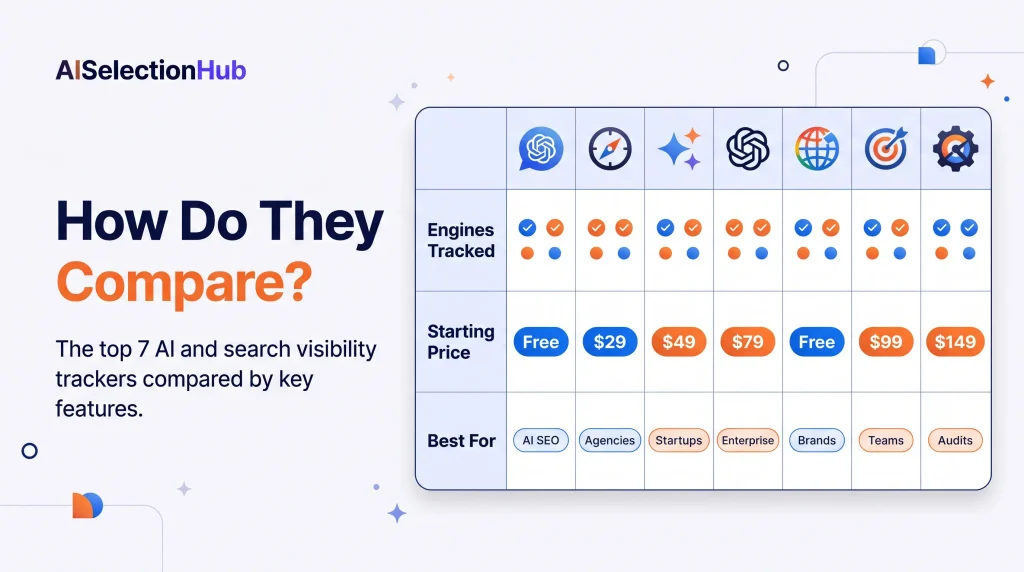
Quick Comparison: Best Generative Engine Optimization Tools at a Glance
| Tool | Best For | Starting Price | Engines Tracked |
|---|---|---|---|
| Profound | Growth & enterprise teams | Custom/enterprise | 9+ |
| Peec AI | Lean marketing teams | ~€85/mo | 5+ |
| Otterly.ai | Ecommerce & budget-conscious teams | ~$29/mo | 7 |
| AthenaHQ | Data-driven growth teams | ~$295/mo | Deep analytics focus |
| Scrunch AI | Content optimization focus | Varies | Multiple |
| Semrush AI Toolkit / Ahrefs Brand Radar | Teams already on Semrush/Ahrefs | Add-on to existing plan | Multiple |
| Gumshoe | Testing the category for free | Free | Basic coverage |
Checklist Before You Buy a GEO Tool
Run through this before committing budget to any of the best generative engine optimization tools on this list:
- Does it track the AI engines your actual customers use, not just the most popular ones?
- Is pricing transparent as prompt/query volume scales, or does it balloon unpredictably?
- Can someone outside the SEO team actually read the dashboard without training?
- Does it correlate citations with any downstream signal (traffic, conversions), or just report raw mentions?
- Is there a free trial or low-cost tier to validate value before a full commitment?
- Does it fit the team shape you actually have — lean marketing, ecommerce catalog scale, or growth-stage reporting needs?
Mistakes People Make When Choosing the Best Generative Engine Optimization Tools
- Picking by brand recognition alone. The most-funded tool isn’t automatically the right fit for a five-person marketing team.
- Ignoring engine coverage until after signing up — my own early mistake, and still the most common one I see.
- Not involving whoever will actually read the dashboard daily in the buying decision.
- Assuming a GEO tool fixes visibility by itself. Tracking tells you where you stand; it doesn’t rewrite your content to earn more citations. For that side of the work, see our guide on how to optimize content for Google AI Overviews.
- Forgetting pricing scales with prompt volume on several of these platforms, which can turn an attractive entry price into a surprise at renewal.
How This Fits Into Your Larger AI Search Strategy
A GEO tool tells you whether you’re being cited. It won’t make your content more citable on its own — that’s still a content and structure problem, not a tooling problem. If you haven’t already, pair whichever tool you choose from this list with an actual content review using our SEO content audit guide, so you’re not just measuring a problem you haven’t started fixing yet.
Frequently Asked Questions
What are the best generative engine optimization tools for a small business or solo marketer? Start with Gumshoe (free) or Otterly.ai (~$29/month) to validate whether GEO tracking surfaces anything actionable before committing to a pricier platform.
How much do GEO tools typically cost? Anywhere from free (Gumshoe) to several hundred dollars a month at the enterprise tier (Profound, AthenaHQ), with most mid-market options landing between $29 and $300/month.
Is GEO the same thing as AEO (Answer Engine Optimization)? They describe largely the same work. AEO is sometimes used more narrowly for featured-snippet-style optimization, while GEO is the broader, more commonly used term for AI-answer visibility as a whole.
Do I need a dedicated GEO tool if I already use Semrush or Ahrefs? Not necessarily right away — both now include GEO modules, which can be a reasonable starting point before you invest in one of the dedicated best generative engine optimization tools on this list.
Final Thoughts
There isn’t a single “best” answer here, and I’d be skeptical of any guide that hands you one. The best generative engine optimization tools for your team depend entirely on team shape, budget, and what you actually plan to do with the data once you have it. Pick based on the role-specific sections above rather than a generic “best overall” badge, and revisit the choice in six months — this category is still young enough that today’s leader may not be next year’s.