 by
by Introduction
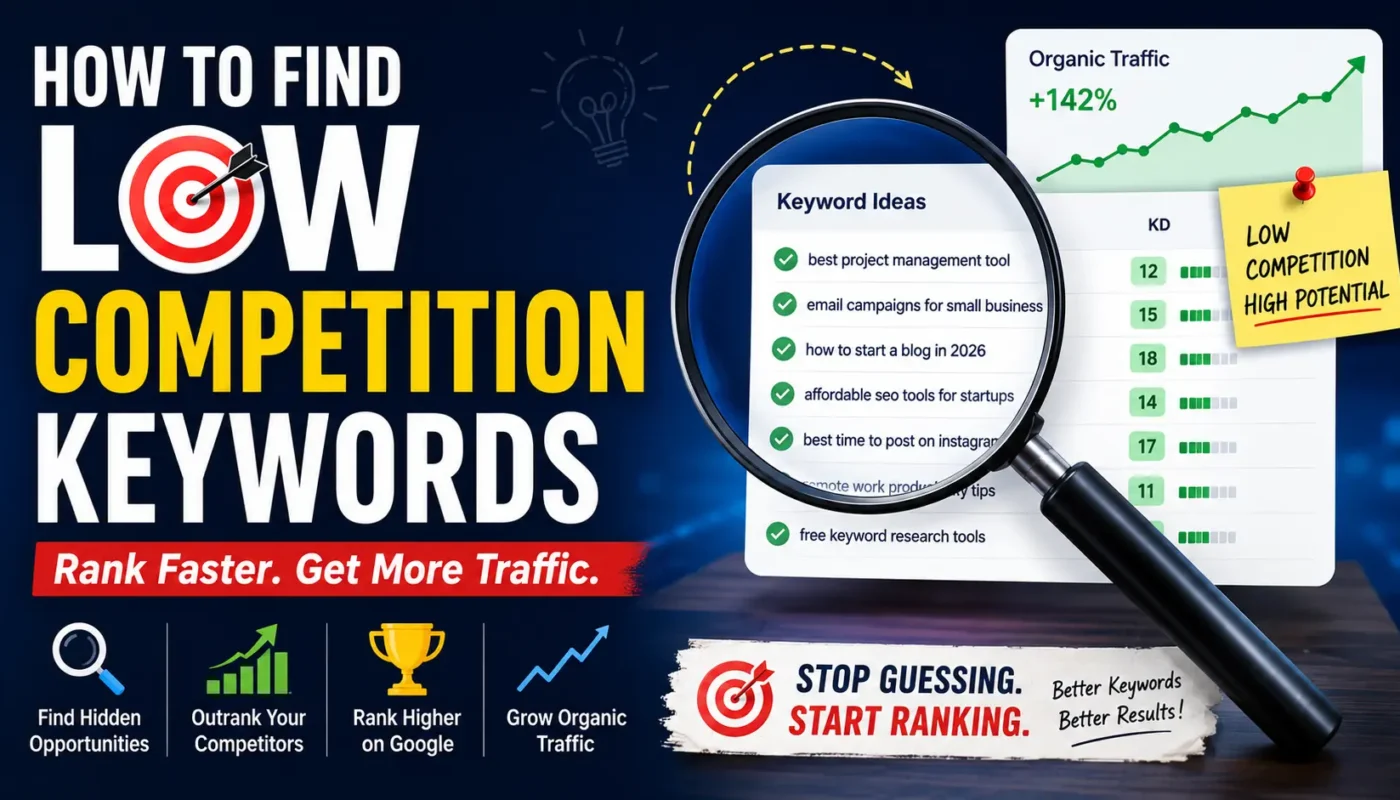
Let’s face it, the old way of searching for “easy” keywords is dead. If you’re still using the filter of “Keyword Difficulty < 20,” and hitting publish without a care in the world, you’re probably asking yourself why your traffic isn’t growing anymore.
In today’s world where AI-generated content is taking over the SERPS (Search Engine Results Pages), “low competition” does not mean what it used to mean. It’s no longer about finding the words that no one will bid on, but rather, it’s about identifying those areas of human experience that AI cannot develop easily. I have seen sites with no backlinks outrank large publishers simply because they targeted the intent of their audience more effectively than the big players.
So if you are sick of just screaming into a void, here’s how we are finding winnable opportunities today.
Why Most Keyword Research Fails (The “Me-Too” Trap)
Most bloggers and marketers are looking at the exact same data. When a popular tool flags a keyword as “Easy,” ten thousand other people see that same green circle. You all write the same 1,500-word skyscraper post, and then you all wonder why you’re stuck on page four.
The problem? Most people treat SEO like a math equation rather than a competition of utility. They ignore:
- SERP Variability: A “Difficulty 10” keyword might be dominated by Reddit and Quora (winnable!) or by a single, high-authority government site (unwinnable).
- The “Good Enough” Content Gap: AI can summarize facts, but it struggles with nuance. If the current Top 10 results are just generic AI summaries, that keyword is “low competition,” regardless of what the SEO tool says.
9 Strategic Ways to Uncover Low-Competition Gold
You don’t need a massive budget, but you do need a better process. Here are the methods I’m currently using to scale organic traffic for niche sites and SaaS brands.
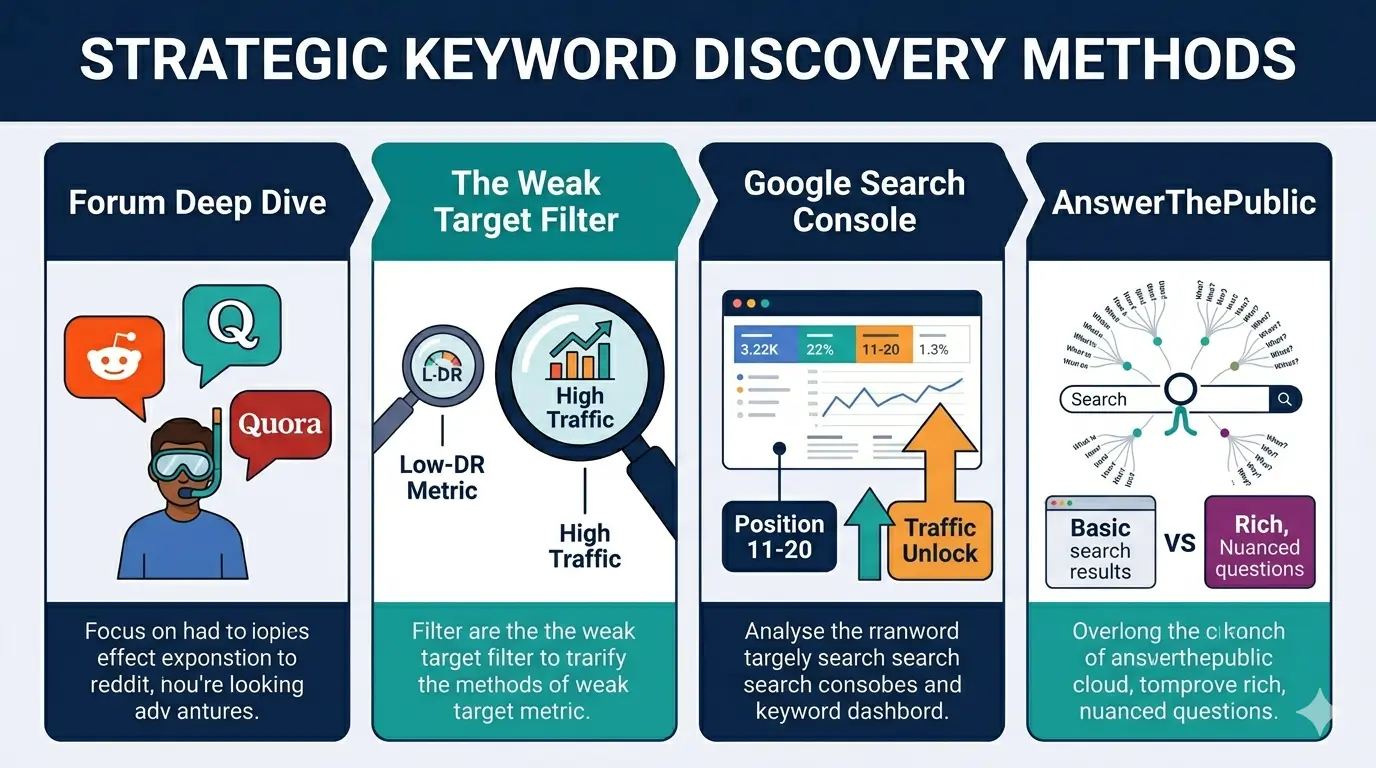
1. The “Forum Deep Dive” (Manual & Mighty)
Go to where people vent their frustrations: Reddit, Quora, or niche-specific forums.
- The Play: Look for threads with lots of engagement but no clear “definitive” answer.
- Why it works: If a 2-year-old Reddit thread is ranking in the Top 5 for a query, Google is literally begging for a high-quality article to replace it.
- Best for: Finding “Zero Volume” keywords that actually drive thousands of visits.
2. Ahrefs / SEMrush: The “Weak Target” Filter
Don’t look at the keyword first; look at the competitors.
- The Play: Find a site in your niche that has a lower Domain Rating (DR) than you but still gets decent traffic. Export their top pages.
- Why it works: If they can rank for it with a weak profile, you can likely steamroll them with better content and internal linking.
3. Google Search Console (The “Hidden Gem” Method)
Your own data is your best friend.
- The Play: Look for keywords where you’re ranking on page 2 (positions 11–20) with high impressions but low clicks.
- The Insight: These are keywords Google wants to rank you for, but your current page isn’t quite hitting the mark. A slight pivot or an update can skyrocket these.
4. Low-DR “Content Gaps”
This is a variation of the competitor analysis but focused on “authority arbitrage.”
- The Play: Use a tool to find keywords where at least two sites in the Top 10 have a DR under 20.
- Who it’s for: New blogs that need to build momentum fast.
5. AnswerThePublic (For Topical Maps)
This tool visualizes the “Who, What, Why” of any topic.
- The Play: Look for the “Comparison” or “Preposition” branches.
- Unique Insight: These long-tail queries often have commercial intent (e.g., “Keyword tool for nonprofits”) that generic guides miss.
6. Exploiting “Alphabet Soup” in Auto-Suggest
Start typing your main keyword into Google and add “a”, then “b”, then “c”.
- The Play: Look for the weirdly specific long-tail phrases that pop up.
- When to use: When you feel like every “main” topic in your niche has been exhausted.
7. Google Trends (The “First Mover” Advantage)
Search for rising breakout terms before the major SEO tools even have data for them.
- The Play: Filter by “Past 90 days” to find trending problems or new software.
- The Benefit: You rank #1 because you’re the only one who wrote about it. By the time the big guys notice, you have the “age” advantage.
8. The “Inverse” Competitor Search
Search for a major competitor and look at what they don’t talk about.
- The Play: Big brands often ignore small, “insignificant” keywords because they don’t move the needle for a billion-dollar company.
- Who it’s for: Small business owners who can thrive on 500 highly-targeted visitors.
9. YouTube Suggest & Comments
YouTube is the second-largest search engine.
- The Play: Look at the comments section of popular videos in your niche. People often ask follow-up questions that have never been answered in a blog post.
- The Limitation: This takes time, but the “user intent” data is pure gold.
Honest Comparison: Which Method Should You Use?
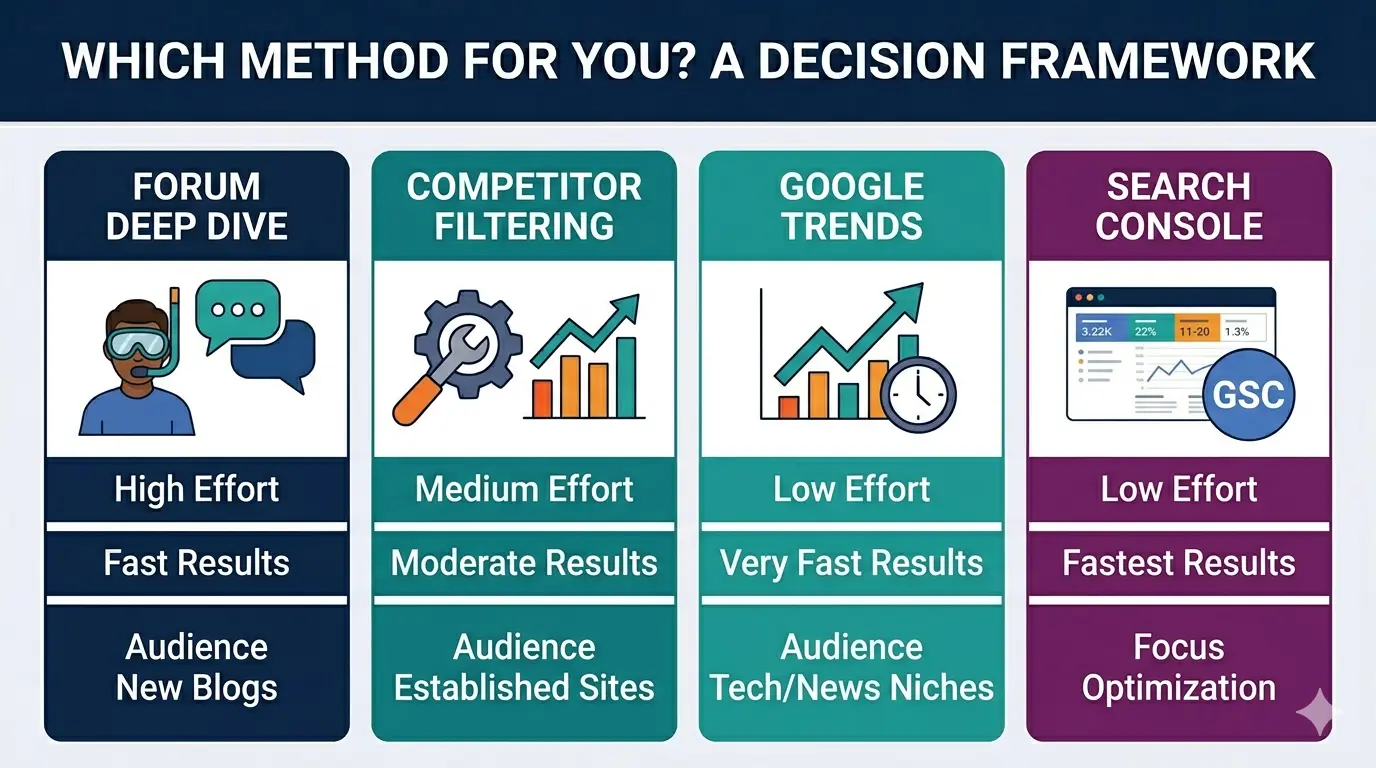
Strategy | Effort Level | Speed of Results | Best For |
Forum Deep Dive | High (Manual) | Fast | New blogs / Niche experts |
Competitor Filtering | Medium (Tool-based) | Moderate | Established sites with some DR |
Google Trends | Low | Very Fast | News-driven niches / Tech |
Search Console | Low | Fastest | Optimizing existing content |
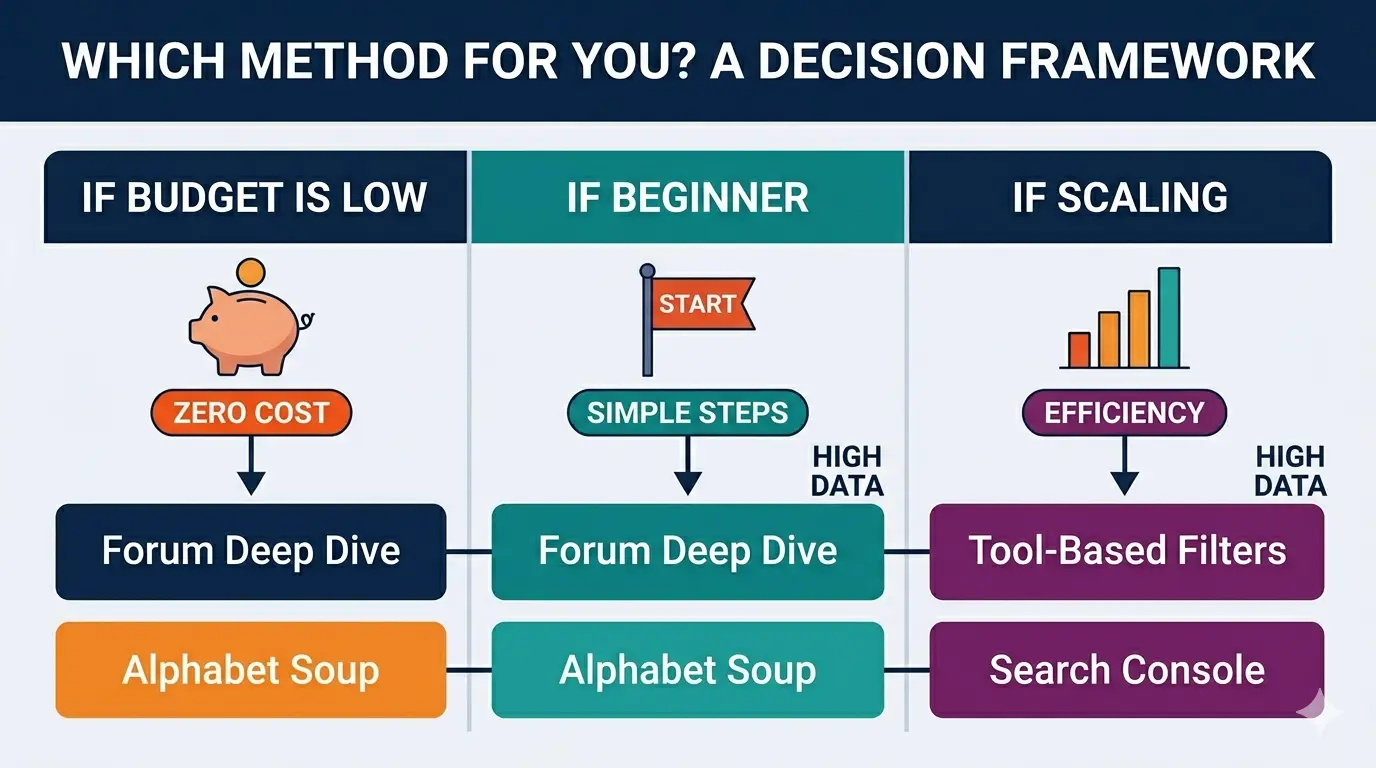
The Reality Check: If you have zero budget, Method 1 (Forums) and Method 6 (Auto-suggest) are your bread and butter. If you’re scaling an agency, you need the efficiency of Method 2 (Weak Target Filtering).
How to Choose: Your 3-Step Decision Framework
- Check the “Who”: Look at the Top 10. Are they big brands (Forbes, NYT, HubSpot)? If yes, walk away—unless you have a radically different angle.
- Check the “How”: Is the current content helpful? If the top results are just generic AI fluff or 10-year-old forum posts, that is your green light.
- Check the “Why”: Why do you want this keyword? If it doesn’t lead to a newsletter sign-up or a product trial, it’s a vanity metric.
Common Mistakes That Kill Your Rankings
- Trusting “Difficulty” Scores Blindly: These are third-party guesses. They don’t know Google’s real-time sentiment. Always manual-check the SERP.
- Ignoring Search Intent: If you target “Best SEO tools” with an informational “How-to” guide, you will never rank. Google knows the user wants a list, not a lesson.
- Forgetting the “After-Click” Experience: Ranking is only half the battle. If users bounce because your site looks like it’s from 1998, Google will demote you.
Pro Tip: If you’re seeing your rankings slip despite doing “everything right,” you might be making some SEO Mistakes to Avoid in 2026 that are specifically tied to how search engines now evaluate E-E-A-T.
Expert Insights: What the Tools Don’t Tell You
The biggest “secret” in SEO right now is Topical Authority. Google doesn’t just rank pages anymore; it ranks entities.
If you want to rank for a low-competition keyword, you need to show you understand the broader context. For example, don’t just write about one keyword; write a cluster. If you’re struggling to see growth, you might need to pivot toward a Strategy to Grow Organic Traffic Without Backlinks, which relies heavily on proving to Google that you are the “Subject Matter Expert” through sheer topical depth.
Also, remember that speed is a competitive advantage. Using the Best SEO Reporting Tools can help you identify these gaps faster than your competitors can react.
Conclusion
Finding low-competition keywords in 2026 isn’t about finding “easy” words; it’s about finding underserved humans. Stop obsessing over the metrics in your dashboard and start looking at the gaps in the search results. Find a question that hasn’t been answered well, answer it with more depth and personality than an AI, and the rankings will follow.