 by
by Introduction
When I first got into digital marketing, I tried doing everything manually—keyword research, tracking rankings, analyzing competitors. It worked… but painfully slow.
The real shift happened when I started using the right SEO tools. Not more tools—just the right ones.
In this guide, I’ll break down the best SEO tools for digital marketing based on real usage, what they’re actually good at, and how to choose without wasting money.
What is Best SEO Tools for Digital Marketing
Simple Explanation
The best SEO tools for digital marketing are platforms that help you research keywords, analyze competitors, track rankings, and optimize content—all with data instead of guesswork.
Think of them as your decision-making engine. They don’t just show data—they help you act on it.
Key Benefits
Better keyword targeting
Find what people are actually searching for
Faster decision-making
No more guessing what might rank
Competitive advantage
See what others are doing—and do it better
Scalable growth
Grow traffic without increasing workload
Quick Summary Points
- Discover high-potential keywords
- Track rankings and performance
- Analyze competitors effectively
- Optimize content for search intent
- Save time with automation
Why People Search for Best SEO Tools for Digital Marketing
Pain Points
- “My content isn’t ranking”
- “I don’t know which keywords to target”
- “Competitors are growing faster than me”
- “SEO feels too complicated”
Real-Life Scenarios
- A blogger publishing content but getting no traffic
- A small business struggling to appear on Google
- A marketer managing multiple campaigns without insights
- A SaaS founder needing organic leads
I’ve personally seen all of these—and tools fix most of them faster than expected.
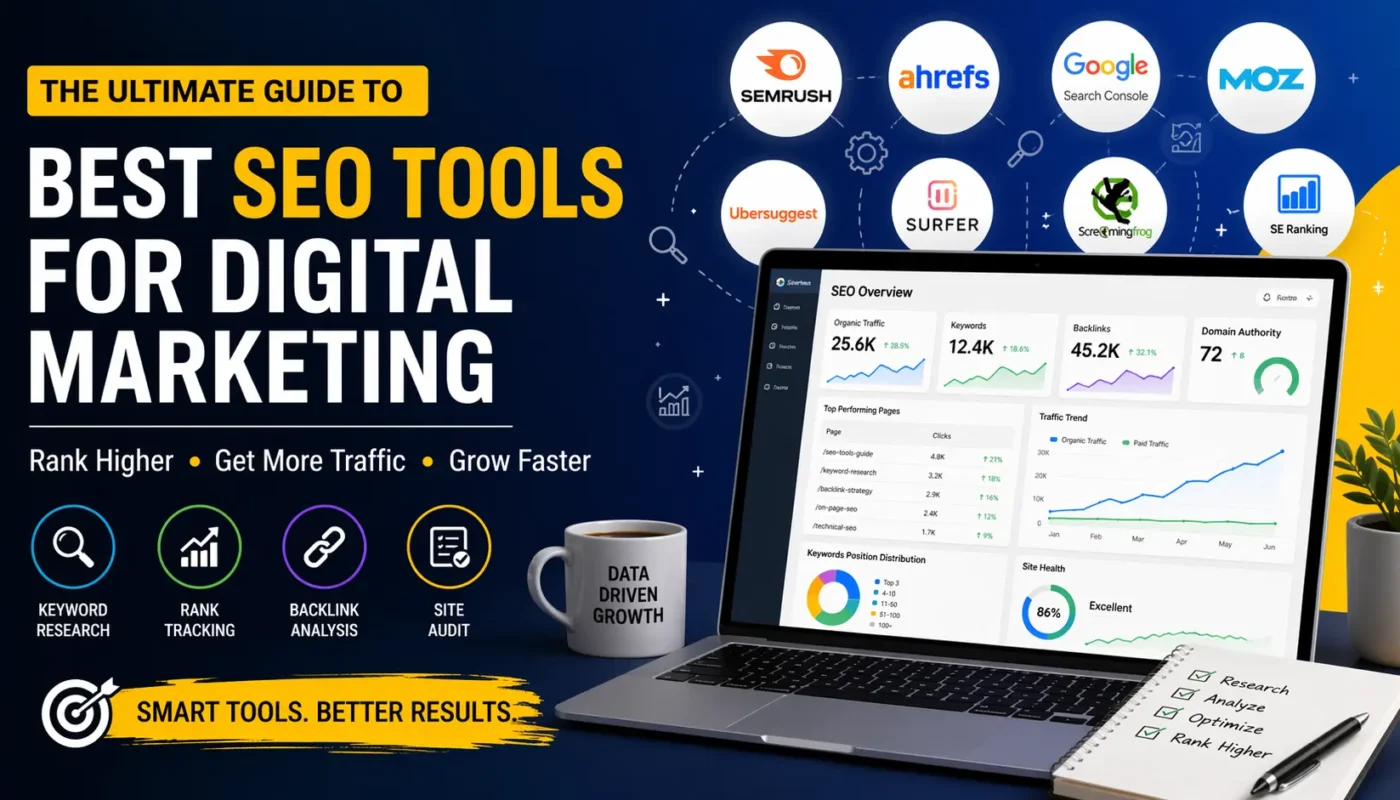
Best SEO Tools for Digital Marketing (Expert Picks)
SEMrush
Features
- Keyword research
- Rank tracking
- Competitor analysis
- Site audit
Benefits
- All-in-one platform
- Reliable data
- Strong competitive insights
Best For
Marketers and agencies
Hidden Insight / Pro Tip
In my experience, SEMrush becomes powerful when you focus on keyword gaps instead of just keyword lists.
Ahrefs
Features
- Backlink analysis
- Keyword explorer
- Content research
Benefits
- Industry-leading backlink data
- Deep SEO insights
Best For
Advanced users and professionals
Hidden Insight
Don’t just use Ahrefs for keywords—use “Top Pages” to reverse-engineer what’s actually driving traffic.
Ubersuggest
Features
- Keyword suggestions
- SEO audit
- Traffic estimation
Benefits
- Beginner-friendly
- Affordable
Best For
New bloggers and small businesses
Hidden Insight
Great for starting—but you may outgrow it once your traffic scales.
Google Search Console
Features
- Performance tracking
- Indexing reports
- Query data
Benefits
- Free and essential
- Direct Google data
Best For
Every website owner
Hidden Insight
Most people ignore the “Queries” tab—this is where hidden keyword opportunities exist.
Google Analytics
Features
- Traffic analysis
- User behavior tracking
- Conversion data
Benefits
- Understand what works
- Improve engagement
Best For
Growth-focused marketers
Surfer SEO
Features
- Content optimization
- NLP keyword suggestions
- SERP analysis
Benefits
- Helps content rank faster
- Data-driven writing
Best For
Content marketers
Hidden Insight
Don’t chase perfect scores—focus on clarity and intent instead.
Moz Pro
Features
- Keyword tracking
- Domain authority
- Site crawl
Benefits
- Easy to use
- Beginner-friendly metrics
Best For
Learning SEO fundamentals
Screaming Frog
Features
- Technical SEO audit
- Website crawling
Benefits
- Finds hidden issues
- Deep technical insights
Best For
Intermediate users
SE Ranking
Features
- Rank tracking
- Competitor analysis
- SEO audit
Benefits
- Budget-friendly
- Clean interface
Best For
Small businesses
Frase
Features
- AI content optimization
- Content briefs
- Keyword insights
Benefits
- Faster content creation
- Better ranking potential
Best For
Content-heavy websites
If you’re just starting, check this beginner-focused guide:
What Are the Best SEO Tools for Beginners? (Complete 2026 Starter Guide)
For deeper understanding:
What Is SEO Tools and Why We Need It? (Complete Beginner-to-Pro Guide)
Want more options?
13 Best SEO Tools for Small Businesses (2026 Guide to Grow Faster)
Interested in AI tools?
Best AI SEO Tracking Tools in 2026 (Smarter Rankings, Faster Growth)
Comparison Table
| Tool | Pricing | Best Use Case | Skill Level |
|---|---|---|---|
| SEMrush | Premium | All-in-one SEO | Intermediate |
| Ahrefs | Premium | Backlink analysis | Advanced |
| Ubersuggest | Low-cost | Beginners | Beginner |
| Search Console | Free | Performance tracking | Beginner |
| Analytics | Free | User behavior | Beginner |
| Surfer SEO | Premium | Content optimization | Intermediate |
| Moz Pro | Medium | SEO basics | Beginner |
| SE Ranking | Medium | Rank tracking | Beginner |
How to Choose the Right Option
Based on Budget
- Free → Search Console, Analytics
- Low → Ubersuggest
- Premium → SEMrush, Ahrefs
Based on Skill Level
- Beginner → Ubersuggest, Moz
- Intermediate → Surfer, SE Ranking
- Advanced → Ahrefs
Based on Goals
- Content SEO → Surfer, Frase
- Rank tracking → SE Ranking
- Full SEO → SEMrush
Common Mistakes to Avoid
Choosing too many tools
Leads to confusion and wasted time
Ignoring free tools
Search Console alone can provide huge insights
Focusing only on data
Without action, tools are useless
Expert Tips
Actionable Tips
- Start with 2–3 tools max
- Focus on low competition keywords
- Track performance weekly
Advanced Strategies
- Combine Search Console + SEMrush
- Build content clusters (not random posts)
- Update old content regularly
- Analyze competitors before writing
Conclusion
The best SEO tools for digital marketing aren’t the most expensive—they’re the ones you actually use consistently.
Start simple, learn the data, and scale gradually.
That’s how real growth happens.